Rainforest Action Network challenges Oreo maker during plenary address at CAGNY, calling for binding protections for forests and human rights defenders
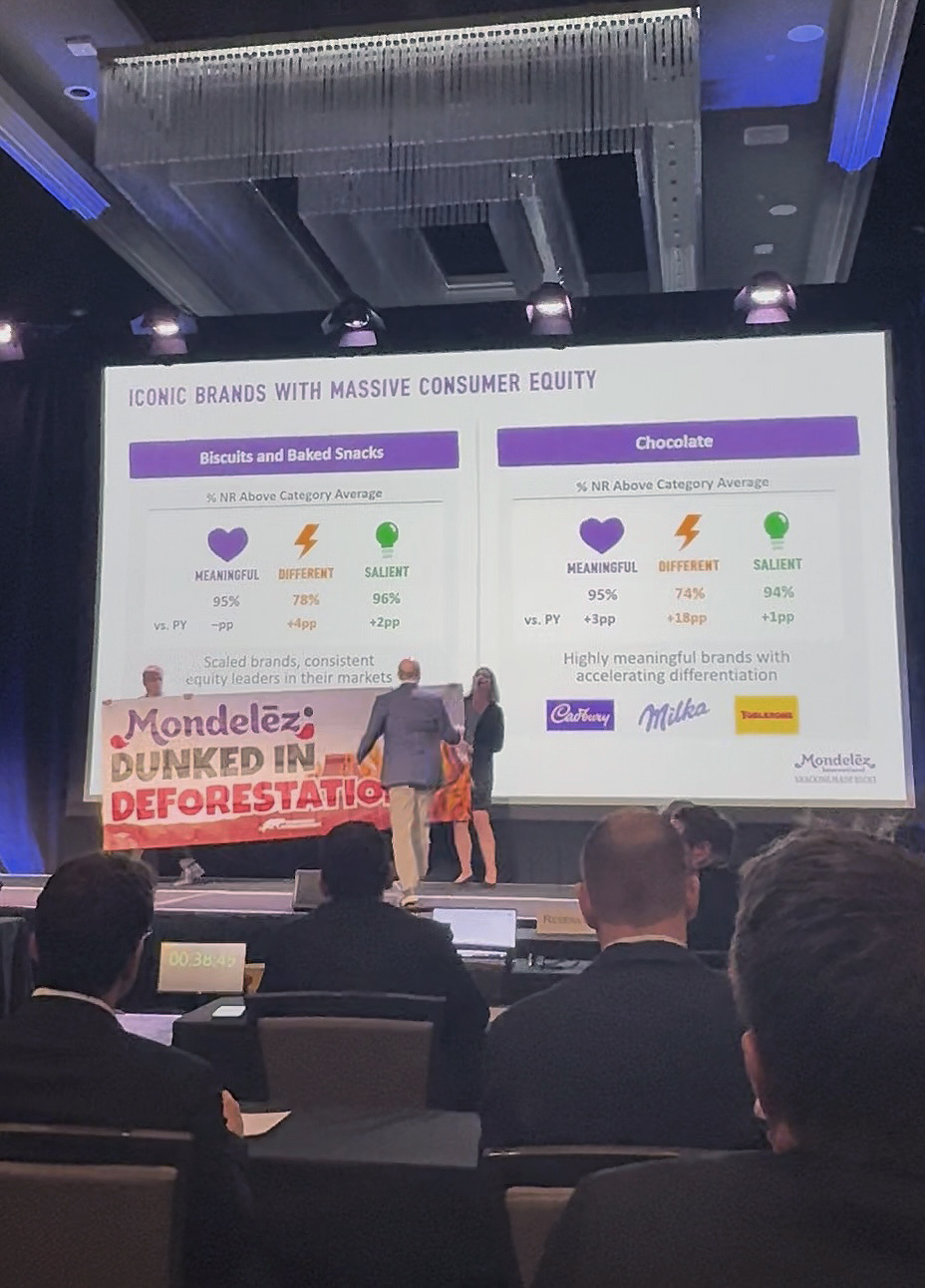
Orlando, FL / San Francisco, CA — Human rights and environmental advocates with Rainforest Action Network (RAN) interrupted Mondelēz International CEO Dirk Van de Put during his plenary address at the Consumer Analyst Group of New York (CAGNY) conference in Orlando today, confronting the company over what they described as ongoing failures to protect rainforests and human rights defenders in its global supply chains.
The disruption unfolded as executives from the world’s largest consumer brands presented to investors about growth strategies and risk management. Activists stood and called on Mondelēz—the maker of Oreo cookies—to adopt and implement robust, enforceable policies to prevent deforestation, land grabs, and violence against Indigenous Peoples and environmental defenders linked to agricultural expansion.
The action coincides with recent findings from RAN’s 2025 Keep Forests Standing Scorecard, which ranked Mondelēz last among ten major consumer goods companies evaluated on their policies and implementation of No Deforestation, No Peat, No Exploitation (NDPE) standards. Mondelēz received an “F” grade, scoring just 4 out of 24 possible points.
“Mondelēz is telling investors a story about resilience and responsible growth,” said Maggie Martin, Forest Campaign Manager at Rainforest Action Network. “But when it comes to protecting forests and the people who defend them, the company is still lagging far behind its peers. We interrupted today because shareholders deserve the full picture.”
According to RAN’s analysis, Mondelēz was the only company evaluated to receive zero points for having a clear, public policy protecting Human Rights Defenders—despite well-documented violence associated with land conflicts in forest-risk commodity supply chains. Between 2015 and 2024, more than 6,400 attacks and over 1,000 killings of land and environmental defenders were recorded globally.
While Mondelēz has made public commitments related to responsible sourcing, RAN says the company has yet to adopt a comprehensive, group-wide NDPE policy covering all forest-risk commodities. The scorecard also found that although Mondelēz now “expects” suppliers to respect Free, Prior, and Informed Consent (FPIC), it lacks transparent systems to independently verify that Indigenous and local communities have actually consented before land development proceeds.
At a time when regulators in key markets are advancing stricter due diligence requirements tied to deforestation and human rights risks—and investors are increasingly scrutinizing environmental and social liabilities—RAN argues that Mondelēz’s current approach exposes the company to reputational, legal, and financial risk.
“Industry leaders are moving beyond paper commitments toward real-world implementation and independent verification,” Martin said. “Mondelēz has failed to put in place the safeguards that communities, investors, and consumers now expect.”
Rainforest Action Network is calling on Mondelēz to:
-
Adopt a clear, public Human Rights Defenders policy with zero tolerance for violence, intimidation, or criminalization linked to its supply chain
-
Implement a strong, group-wide NDPE policy covering all forest-risk commodities
-
Establish independent monitoring and transparent reporting to ensure verified compliance across its global operations
“We are here today because we have presented Mondelez decision makers with abundant, credible evidence of the destruction and abuses in its supply chain, but the company has so far refused to take meaningful action,” said Martin.