Key Findings
- Methane/LNG expansion is a growing threat to biodiversity on the US Gulf Coast and around the world.
- Financial institutions backing methane expansion are failing to address the significant biodiversity risks stemming from these projects, exacerbating the global biodiversity crisis.
- Banks and insurers should adopt and strengthen policies to exclude financing and underwriting of methane expansion in critical biodiversity areas, while adopting time bound plans to phase out all support for fossil fuel expansion.
Currently, there are 36 liquefied natural gas terminals and expansion projects proposed, under construction or actively operating in the United States, with 28 concentrated in the Gulf Coast.1 Liquefied natural gas (LNG), more accurately known as methane gas, is often fracked gas that is supercooled to a liquid state in preparation for transport overseas on tankers. Developers of methane export terminals have exploited the geographic and financial advantages offered by the Gulf Coast, including ready access to ports and shorelines, proximity to major fracking basins,2 and tens of billions in tax breaks,3 4 to create the concentration of terminals we see today.
Methane gas export operations in the US have accelerated in recent years due to the fracking boom and the Russian invasion of Ukraine, presently making the United States the top methane gas exporter in the world.5 Moreover, there are early signs that the crisis in Iran and the Middle East is sparking a new push to expand US gas production even further.
Methane gas is a potent greenhouse gas, with 80 times the warming potential of carbon dioxide.6 The methane gas industry is one of the highest carbon-emitting sectors, with a greenhouse gas footprint exceeding that of the coal industry across its full life cycle including substantial emissions from its transportation and end use.7 The entire methane gas value chain carries significant human, environmental and climate-related risks:8 Methane gas is a potent greenhouse gas, with 80 times the warming potential of carbon dioxide,9 and various reports have documented the ongoing water and air pollution,10 destruction of critical habitats and soils,11 violations of Indigenous rights,12 and financial risks13 of LNG.
This brief is the second in a series spotlighting the manifold risks of the LNG industry. The first brief underscored the financial risks of the LNG buildout in the Gulf South. Here we summarize the severe ongoing and potential biodiversity impacts of LNG in the Gulf Coast and highlight the urgent need for financial backers of LNG terminals to adopt more robust and meaningful biodiversity standards.
Widespread Biodiversity Harms along the LNG Export Value Chain
The Gulf South is a region of great ecological importance,14 containing some of the most biologically diverse and productive habitats in the US15 with over 15,000 documented species,16 130 of which are federally protected.17 18 The Gulf Coast region holds 66% of the country’s vital estuarine wetlands,19 which protect shorelines from erosion and floods, improve water quality, store carbon and offer critical nurseries for fish, invertebrates, shellfish and other wildlife.20 The Gulf Coast includes two major migratory bird flyways21 and is home to 61% of bird species in the US, making it one of the most important areas for waterfowl in North America.22 Commercial and recreational fishing, which form the backbone of local economies in Gulf states, relies on habitats provided by estuarine wetlands.23 The seafood industry in Louisiana and Texas alone generated $6.2 billion in sales in 2023.24 However, these ecosystems are increasingly at risk, as the Gulf is experiencing the most dramatic loss25 in wetlands than any other coastal area in the country.26
LNG export facilities disrupt the intricate and interdependent web of the Gulf ecosystem. From construction to regular operations to transport, LNG terminals in the Gulf Coast destroy critical wetlands and underwater habitats, release toxic pollution into the air and water, emit disorientingly high levels of light and noise, and smother marine nurseries in dredged sediment. Taken in whole, LNG export activities create both a human and ecological sacrifice zone, imperiling up to 100 special status species,27 28 including whales, sea turtles, corals, dolphins, ocelots, migratory birds, snakes and bats. There is global recognition of the importance of preserving International Union for Conservation of Nature (IUCN) protected areas and Key Biodiversity Areas (KBAs) – which are globally significant sites for conservation – crucial places on our planet where unique species and ecosystems occur in important numbers or extent.29
IUCN protected areas and KBAs are home to critical populations of the world’s species and ecosystems, and safeguarding these areas can ensure the conservation of the largest and most important populations, as well as the most crucial parts of ecosystems.
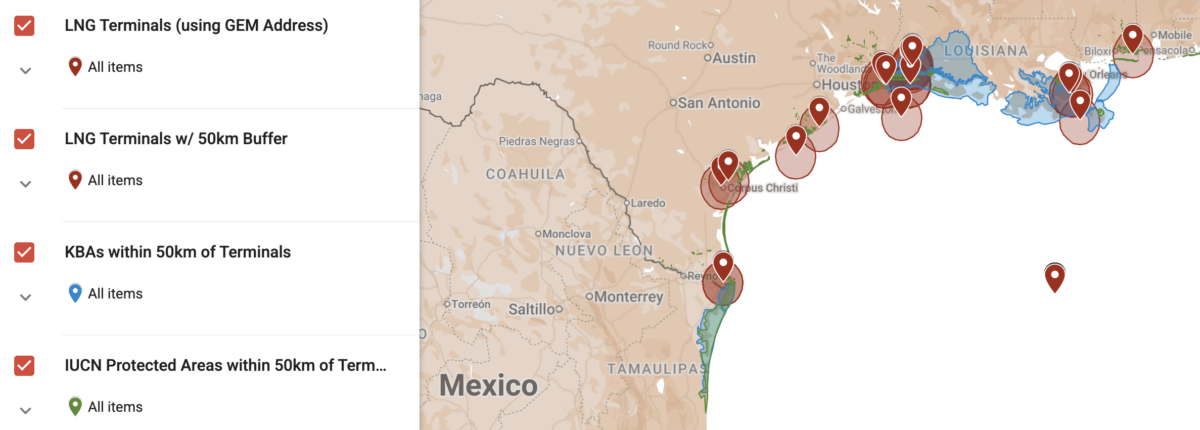
Several methane terminals threaten KBAs in the Gulf Coast. For example, Cameron LNG, the Sabine Pass LNG and Venture Global’s Calcasieu Pass LNG and CP2 LNG are located within the Chenier Plain KBA. Woodside Louisiana LNG and Magnolia LNG (when built) are located on the border of the Chenier Plain and Coastal Prairie KBAs. Corpus Christi LNG is to the southwest of the Blackjack Peninsula of Aransas National Wildlife Refuge KBA, which qualifies as a KBA of international significance.30 Venture Global’s Plaquemines LNG and the proposed Gulfstream LNG both are located along the border of the Barataria Terrebonne KBA. Both the Rio Grande LNG and Texas LNG Brownsville are within a short distance of several KBAs: Delta del Río Bravo, Laguna Madre, Green Island, and Laguna Vista Spoils.
IUCN protected areas are also at risk from nearby LNG facilities. Freeport LNG is located between the Brazoria National Wildlife Refuge, Christmas Bay Coastal Preserve, Justin Hurst Wildlife Management Area, and the San Bernard National Wildlife Refuge.31 Rio Grande LNG is near the Laguna Atascosa National Wildlife Refuge and the Lower Rio Grande Valley National Wildlife Refuge, both IUCN Category IV protected areas.32 Sabine National Wildlife Refuge, also a Category IV protected area, is surrounded by a cluster of existing and proposed LNG projects including Cameron LNG, Woodside Louisiana LNG, Magnolia LNG, Calcasieu Pass LNG, Commonwealth LNG, Sabine Pass LNG, Golden Pass LNG, Lake Charles LNG and Port Arthur LNG.
As we detail further below, financial institutions have a responsibility to adopt policies that, at minimum, exclude oil and gas financing and underwriting that impacts Key Biodiversity Areas and IUCN protected areas to conserve these critical areas.
Key Biodiversity Areas (KBAs)
KBAs are a global standard for “sites contributing significantly to the global persistence of biodiversity in terrestrial, inland water and marine environments.”33 KBAs meet specific criteria under the following categories:34
-
- Threatened biodiversity: sites that support significant populations of species or ecosystems at risk of extinction.
- Geographically-restricted biodiversity: sites that hold species or ecosystems with limited global ranges or extent.
- Ecological integrity: sites with intact ecological communities that maintain natural processes and have low human impact.
- Biological processes: sites critical for key life-cycle events such as breeding aggregations, refuges, or recruitment sources.
- Irreplaceability: sites essential for achieving conservation goals, where loss would significantly reduce options for biodiversity protection.
International Union for Conservation of Nature (IUCN) Protected Areas
Protected areas, as defined by IUCN, are those “clearly defined geographical space[s], recognized, dedicated and managed, through legal or other effective means, to achieve the long-term conservation of nature with associated ecosystem services and cultural values.”35 Protected areas include the following categories:36
-
- Category Ia: Strict Nature Reserve
- Category Ib: Wilderness Area
- Category II: National Park
- Category III: Natural Monument or Feature
- Category IV: Habitat/Species Management Area
- Category V: Protected Landscape or Seascape
- Category VI: Protected Areas with Sustainable Use of Natural Resources
Impacts due to Construction
Currently, five LNG terminals are operational and an additional seven are under construction in the Gulf Coast.37 Bringing an LNG export terminal online is a massive undertaking involving the construction of pretreatment facilities, access roads, liquefaction trains, storage tanks, power generation facilities, loading docks, pipelines and even levee systems.38 39 40 These activities often require temporary and permanent alterations to land and waterways that disrupt and destroy critical habitats and wildlife.
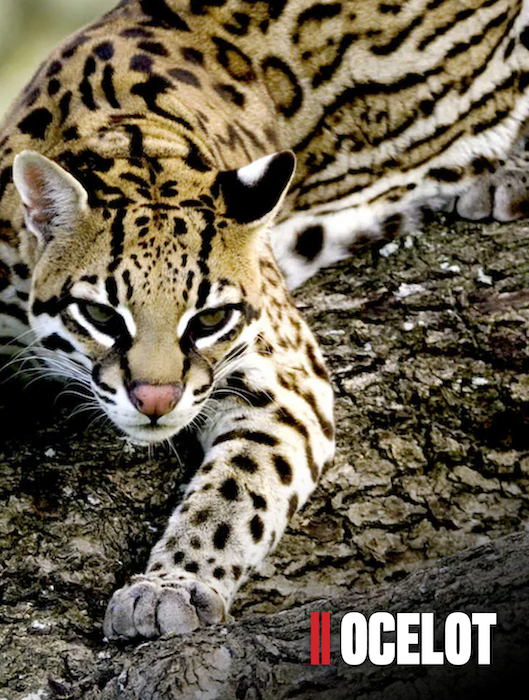
Construction and expansion of LNG terminals results in wetland loss, dispersal of historical contamination, wildlife injury and mortality, soil erosion and compaction, and removal of prime farmland. Already, 5,411 acres of land has been permanently affected, with 1,123 acres of wetlands forever lost. Future LNG construction and expansion threatens at least 21,000 acres of wetlands.41 Woodside Louisiana LNG and Corpus Christi LNG both are sites with historical soil contamination, with groundwater and soil tests at Woodside Louisiana LNG exceeding standards for highly toxic volatile organic compound (VOC) concentrations. The degradation and loss of these habitats imperils such threatened species as the Coastal Live Oak-Hackberry Forest42 ocelots, Northern Aplomado Falcon, piping plovers and Gulf Coast jaguarundi.43
LNG development also often relies on dredging nearby waterways to allow for ship travel. Across five Gulf Coast LNG facilities, an estimated total of 19.4 million cubic yards was or will be dredged – enough to cover over 9,000 football fields with 1 foot of sediment.44 Excavating waterways can physically destroy aquatic habitats, increase suspended sediment thereby reducing available oxygen, and release historical contamination in the soils from industrial activities (e.g., petrochemical pollution in the Freeport Harbor Channel). Dumping dredged material can degrade the soil and water quality at and downstream of these sites, and has resulted in the total loss of critical natural wetland ecosystems. Indeed, in August 2025, dredging of the Port of Cameron near Venture Global’s CP2 terminal resulted in vast amounts of dumped sludge flowing into downstream bayous,45 causing widespread die-offs of aquatic life and oyster, fish, shrimp and crab hauls covered in mud that was likely contaminated.46
Construction activities also create noise and light pollution. Local wildlife, particularly migratory birds, experience stress and disorientation from light pollution, affecting their feeding, breeding and nesting.47 The pile driving used to build docks can directly injure fish and sea turtles, and generate loud noises and vibrations that impair communication, hearing and behaviors of marine animals.48

Impacts of Operations
Once an LNG facility is online, regular operations carry forward many of the risks discussed in the construction phase, including industrial noise, light pollution, habitat loss and fragmentation, and maintenance dredging which typically occurs every few years.49 These activities compound the impacts from construction on local terrestrial and aquatic ecosystems.
LNG operations also introduce additional risks to wildlife, particularly through air and water pollution. Natural gas compressor engines used by liquefaction trains are one of the largest sources of air pollution from LNG facilities,50 though leaks, fires, flaring51 and even explosions52 are also major contributors of emissions. These emissions include a bevy of highly toxic substances such as VOCs, particulate matter, ozone, sulfur dioxide, nitrous oxides, carbon monoxide, greenhouse gases and formaldehyde. A recent study suggests that all of the Gulf Coast LNG terminals operational by the end of 2024 were in open violation of the Clean Air Act and air pollution control permits at least once in recent years. Moreover, these terminals released over 16.8 million tons of greenhouse gases and 15,441 tons of air pollutants in 2023 alone.53 These pollutants pose health harms to humans and wildlife and accelerate the effects of climate change on the already vulnerable ecosystems of the Gulf Coast.
LNG facilities also generate wastewater in their operations, from processing gas, cleaning and testing equipment and in the form of stormwater runoff and sanitary wastewater. Terminals often release this effluent to local waterways or transport it off-site. The five operational LNG terminals in the Gulf Coast exceeded Clean Water Act standards 69 times over five years, involving releases of suspended solids, zinc, copper, bacteria, oil, and grease,54 posing risks to local wildlife.

Impacts due to Transport
LNG export terminals use large tankers to transport liquefied natural gas to buyers overseas. Recent studies estimate LNG tankers take around 1,300-1,400 trips55 56 in and out of Gulf ports each year. Vessel traffic is associated with numerous threats to biodiversity along the Gulf Coast. LNG tankers release harmful ballast water and wastewater, produce underwater noise and vibration, generate shoreline erosion from their wake, physically strike marine species, increase suspended sediment, leach ship paint,57 belch air pollution and require maintenance dredging.
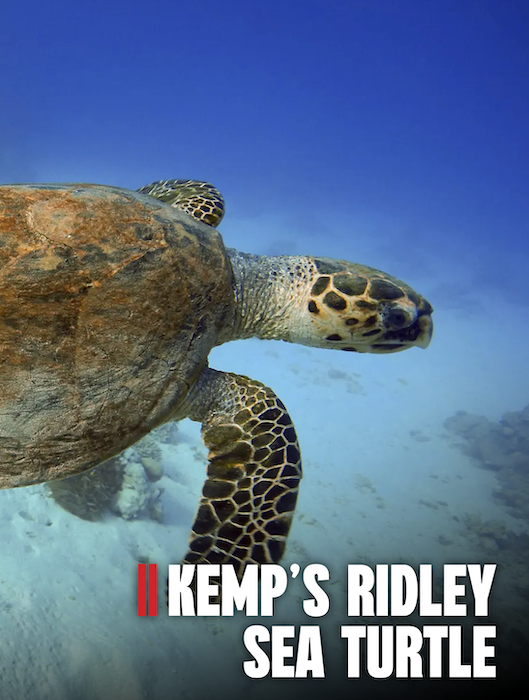
LNG vessels often cross migration routes and core habitats of aquatic species, resulting in collisions that injure or kill marine animals. Particularly at risk are slow moving species such as whales and sea turtles that spend time at the surface of the water. Specifically, the Gulf contains two “Biologically Important Areas” (BIAs)58 for the nearly extinct Rice’s whales and bottlenose dolphins.59 The endangered Kemp’s ridley sea turtle, sperm whales and the West Indian manatee are additional species that have been identified as being at risk for LNG ship strikes.60
Research has shown that the low-frequency underwater noise and vibration generated by LNG carriers has the potential to significantly disturb the communication, feeding, hearing and reproduction of sensitive marine animals.61 Typical tanker noise has been recorded at upwards of 170 decibels (dB), easily exceeding federal thresholds for marine mammals and even the world’s loudest metal bands.62
The transit and operation of LNG carriers degrades underwater and coastal habitats. Wave action from the movement of these tankers causes shoreline retreat, averaging 1 to 3 feet per year in some areas,63 and churns up sediment, impairing fishing.64 Maintenance dredging required for tanker access destroys the underwater habitats of invertebrates, fish and shellfish which often form the basis of local food webs and local economies.65 Moreover, tankers release ballast water which can introduce invasive and nuisance species into the fragile ecosystems. Vessels emit greenhouse gases and pollutants that add to the air pollution generated by LNG terminals.66
LNG Financiers Policies Fail to Account to Robust Biodiversity Standards
The world’s largest banks and insurance companies play a pivotal role in enabling these biodiversity harms by continuing to finance the expansion of LNG and other fossil fuels while neglecting to hold themselves and their clients to stronger standards.
Broadly speaking, the financial sector’s stated commitments to preserving biodiversity are out of step with their actual lending and underwriting practices. Recent estimates suggest that US banks have $1.7 trillion in loans exposed to nature-related risks67 and that 83% of corporate managers expect that their business will be impacted by biodiversity loss.68 Many of the world’s major financial institutions have inadequate policies to guide financing decisions and assess biodiversity impacts of their client’s projects. A recent report found that where policies and plans did exist, many referenced weak or voluntary disclosure frameworks such as the Equator Principles, International Finance Corporation Performance Standards, and the Task Force on Nature-related Financial Disclosures (TNFD).69 These policies do not align with the urgent mandate of the Global Biodiversity Framework (GBF) to stop and reverse biodiversity loss by 2030, set out by the UN COP15 Convention on Biological Diversity.70
Major financiers of LNG projects in the Gulf Coast reference these inadequate frameworks as part of their biodiversity strategies, with many not even going that far. Indeed in 2024, Gulf Coast LNG financiers JPMorgan Chase, Citi, Bank of America and Wells Fargo all withdrew as signatories to the Equator Principles.71 Bank of America’s 2025 Sustainability Report72 touts their membership in the TNFD. Citi’s Environmental and Social Framework73 relies on IFC Performance Standards and national and local laws to ensure clients are compliant. Yet, the LNG projects these banks finance are often in open violation of relevant air and water pollution laws, with little recourse.
Adopting Key Biodiversity Area (KBA) exclusion policies for oil and gas financing and underwriting would apply to many Gulf Coast LNG projects. For example, Venture Global’s Calcasieu Pass LNG and CP2 LNG are both within the boundaries of a Key Biodiversity Area, the Chenier Plain (KBA ID 29623),74 along with the existing terminals: Cameron LNG, Sabine Pass LNG and proposed Commonwealth LNG, Magnolia LNG, and Woodside Louisiana LNG, and Lake Charles LNG in Coastal Prairie KBA. Rio Grande LNG and Texas LNG threaten some of the Gulf’s IUCN protected areas. Rio Grande LNG is located directly between the Laguna Atascosa National Wildlife Refuge75 and the Lower Rio Grande Valley76 – both of which are International Union for Conservation of Nature (IUCN) protected areas.
Banks and insurers should adopt IUCN policies and strengthen their policies to address the cascading impact that oil and gas operations can have on nearby protected areas to avoid focusing too narrowly on projects located within defined boundaries. Policies that account for impact on IUCN protected areas—like establishing a buffer zone of at least 10 km for terrestrial areas and 50 km for marine areas where the impact radii of potential pollution and disruption is carried wider by water currents77—would be applicable to a number of existing and proposed Gulf Coast LNG terminals considering the following IUCN areas in the region; Sabine National Wildlife Refuge,78 Cameron Prairie National Wildlife Refuge,79 Texas Point National Wildlife Refuge,80 J.D. Murphy National Wildlife Refuge.81
Chubb and Swiss Re both have some IUCN restrictions on oil & gas that could be built upon.82 Allianz and Swiss Re both have standards restricting impacts on IUCN Red List endangered species and should apply these policies to the aforementioned impacts their Gulf Coast LNG underwriting has on these species. Aviva is demonstrating industry leadership on biodiversity goals and assessments and would benefit from operationalizing these findings with the adoption of more specific protection/restriction policies like its peers.83
Several banks financing LNG projects outside of the Gulf Coast are facing backlash for their risks to biodiversity. The Japan Bank for International Cooperation (JBIC) has poured $18.6 billion into LNG production over the past decade, with groups raising concerns over the grave biodiversity impacts of JBIC-backed LNG projects in the Philippines, Thailand and Indonesia.84 TotalEnergies and Mitsubishi UFJ Financial Group (MUFG) are scrambling to find backers for the Papua LNG project as nearly 30 banks withdrew their support over biodiversity, climate and human rights risks.85 JPMorgan Chase is facing pressure over its advisory role in the Saguaro Energia LNG project, due to the project’s projected impacts to a world-renowned biodiversity hotspot in Mexico.86
The need for biodiversity safeguards in fossil fuel financing and underwriting
Financial institutions have an obligation to recognize and be accountable for the severe threats posed by LNG operations to biologically, economically and culturally important ecosystems around the world, including in the Gulf Coast. In order to protect the world’s remaining biodiversity, it is vitally important for financial institutions to adopt policies that prevent financing and underwriting for fossil fuel and LNG expansion in Key Biodiversity Areas, while also adopting time bound plans to phase out financing for all fossil fuel expansion globally and scale up support for a just energy transition that supports climate, biodiversity and human rights.

ENDNOTES
- https://www.ferc.gov/media/us-lng-export-terminals-existing-approved-not-yet-built-and-proposed
- https://ieefa.org/north-american-lng-export-tracker#section1
- https://www.sierraclub.org/press-releases/2025/03/new-report-tax-handouts-wealthy-lng-developers-deprive-communities-needed
- https://www.sierraclub.org/press-releases/2025/03/new-report-tax-handouts-wealthy-lng-developers-deprive-communities-needed
- https://www.eia.gov/todayinenergy/detail.php?id=67224
- https://www.ucs.org/resources/environmental-impacts-natural-gas
- https://scijournals.onlinelibrary.wiley.com/doi/10.1002/ese3.1934
- https://exitlng.org/communities-and-ecosystems/
- https://www.ucs.org/resources/environmental-impacts-natural-gas
- https://environmentalintegrity.org/news/boosted-by-trump-administration-lng-industry-violates-pollution-limits/
- https://www.ucs.org/resources/environmental-impacts-natural-gas
- https://www.firstnations.org/stories/finding-a-voice-and-making-it-heard-defending-native-rights-on-the-border/
- https://www.ran.org/climate-breakdown/doubling-down-on-sinking-ground-the-financial-risks-of-us-gulf-coast-lng-export/
- https://biologicaldiversity.org/programs/energy-justice/pdfs/Impacts-of-LNG-exports-Center-factsheet-2024.pdf
- https://www.fws.gov/rivers/carp/program/deepwater-horizon-gulf-restoration/species
- https://www.harteresearch.org/collaboration/biodiversity-gulf-mexico
- https://www.fws.gov/rivers/carp/program/deepwater-horizon-gulf-restoration/species
- https://www.fisheries.noaa.gov/southeast/consultations/threatened-and-endangered-species-list-gulf-america
- https://www.epa.gov/gulfofamerica/why-habitat-restoration-near-gulf-america-essential
- https://www.epa.gov/wetlands/about-coastal-wetlands
- https://www.fws.gov/rivers/carp/program/deepwater-horizon-gulf-restoration/species
- https://cdn.prod.website-files.com/614d88a190900e498857f581/664604a23f64fa6444dd2a2b_Bullard%20Center%20Liquefying%20the%20Gulf%20Coast%20Report.pdf
- https://coastalresilience.tamu.edu/home/wetland-protection/value-of-coastal-fisheries-and-wetlands/
- https://www.fisheries.noaa.gov/s3//2026-02/FEUS-2023-web_0.pdf
- https://tos.org/oceanography/article/the-gulf-of-mexico-an-overview
- https://www.fisheries.noaa.gov/national/habitat-conservation/coastal-wetland-habitat
- https://biologicaldiversity.org/programs/energy-justice/pdfs/Impacts-of-LNG-exports-Center-factsheet-2024.pdf
- https://cdn.prod.website-files.com/614d88a190900e498857f581/664604a23f64fa6444dd2a2b_Bullard%20Center%20Liquefying%20the%20Gulf%20Coast%20Report.pdf
- In addition to IUCN protected areas (Categories I-VI) and KBAs, other internationally recognized scientific frameworks and nationally designated protected areas that financial institutions should design policies to align with include, but are not limited to: UNESCO World Heritage Sites, Ramsar Wetlands, Important Marine Mammal Areas (IMMAs), Marine Protected Areas (MPAs), Ecologically or Biologically Significant Marine Areas (EBSAs), Particularly Sensitive Seas (PSSA), Indigenous Peoples’ and Community Conserved Areas (ICCAs), Important Shark and Ray Areas (ISRA). For more information on how these various frameworks compare to one another please see the “Defining Critical Biodiversity Areas” policy note from Reclaim Finance at https://reclaimfinance.org/site/wp-content/uploads/2026/04/Policy-Note_Defining-Critical-Biodiversity-Areas_v042026-1.pdf
- https://www.keybiodiversityareas.org/map
- https://www.protectedplanet.net
- https://www.protectedplanet.net
- https://kbacanada.org/wp-content/uploads/2022/09/WWF2017_Technical-Paper-The-Relationship-Between-KBAs-and-Other-Designations.pdf
- https://www.keybiodiversityareas.org/contribute-your-kba-network/assessment-and-monitoring/criteria
- https://portals.iucn.org/library/sites/library/files/documents/pag-021.pdf
- https://portals.iucn.org/library/sites/library/files/documents/pag-021.pdf
- https://www.ferc.gov/media/us-lng-export-terminals-existing-approved-not-yet-built-and-proposed
- https://cdn.prod.website-files.com/614d88a190900e498857f581/664604a23f64fa6444dd2a2b_Bullard%20Center%20Liquefying%20the%20Gulf%20Coast%20Report.pdf
- https://environmentalintegrity.org/wp-content/uploads/2022/09/Chapter-2-LNG-guide-8_11_22-v3-1.pdf
- https://www.goldenpasslng.com/operations/export-project#facility-assets
- https://news.oilandgaswatch.org/post/proposed-lng-export-terminals-threaten-22-000-acres-of-wetlands-many-in-louisiana
- https://www.wlf.louisiana.gov/assets/Resources/Publications/Natural_Communities_Fact_Sheets/Coastal_Live_Oak-Hackberry_Forest.pdf
- https://biologicaldiversity.org/programs/energy-justice/pdfs/Impacts-of-LNG-exports-Center-factsheet-2024.pdf
- https://cdn.prod.website-files.com/614d88a190900e498857f581/664604a23f64fa6444dd2a2b_Bullard%20Center%20Liquefying%20the%20Gulf%20Coast%20Report.pdf
- https://gasoutlook.com/analysis/dredge-operation-near-venture-globals-cp2-spills-into-fish-habitat/
- https://habitatrecovery.org/cp2-timeline
- https://cdn.prod.website-files.com/614d88a190900e498857f581/664604a23f64fa6444dd2a2b_Bullard%20Center%20Liquefying%20the%20Gulf%20Coast%20Report.pdf
- https://cdn.prod.website-files.com/614d88a190900e498857f581/664604a23f64fa6444dd2a2b_Bullard%20Center%20Liquefying%20the%20Gulf%20Coast%20Report.pdf
- https://cdn.prod.website-files.com/614d88a190900e498857f581/664604a23f64fa6444dd2a2b_Bullard%20Center%20Liquefying%20the%20Gulf%20Coast%20Report.pdf
- https://cdn.prod.website-files.com/614d88a190900e498857f581/664604a23f64fa6444dd2a2b_Bullard%20Center%20Liquefying%20the%20Gulf%20Coast%20Report.pdf
- https://environmentalintegrity.org/wp-content/uploads/2025/10/LNG-Report-nonembargoed-10.29.25.pdf
- https://www.ferc.gov/industries-data/resources/project-directory/freeport-lng-incident-june-2022
- https://environmentalintegrity.org/wp-content/uploads/2025/10/LNG-Report-nonembargoed-10.29.25.pdf
- https://environmentalintegrity.org/wp-content/uploads/2025/10/LNG-Report-nonembargoed-10.29.25.pdf
- https://www.researchgate.net/publication/394406709_Emissions_and_Underwater_Noise_from_LNG_Carrier_Vessels_-_A_Study_of_the_Potential_Impacts_of_LNG_Development_on_Marine_Mammals_in_the_Gulf_of_California
- https://cdn.prod.website-files.com/614d88a190900e498857f581/664604a23f64fa6444dd2a2b_Bullard%20Center%20Liquefying%20the%20Gulf%20Coast%20Report.pdf
- https://www.epa.gov/ports-initiative/ports-primer-71-environmental-impacts
- https://www.energy.gov/documents/15-rice-environmental-impacts-marine-mammalspdf
- https://biologicaldiversity.org/programs/energy-justice/pdfs/Impacts-of-LNG-exports-Center-factsheet-2024.pdf
- https://biologicaldiversity.org/programs/energy-justice/pdfs/Impacts-of-LNG-exports-Center-factsheet-2024.pdf
- https://www.researchgate.net/publication/394406709_Emissions_and_Underwater_Noise_from_LNG_Carrier_Vessels_-_A_Study_of_the_Potential_Impacts_of_LNG_Development_on_Marine_Mammals_in_the_Gulf_of_California
- https://journals.sagepub.com/doi/pdf/10.1177/014107689208501010
- https://cdn.prod.website-files.com/614d88a190900e498857f581/664604a23f64fa6444dd2a2b_Bullard%20Center%20Liquefying%20the%20Gulf%20Coast%20Report.pdf
- https://gasoutlook.com/analysis/dredge-operation-near-venture-globals-cp2-spills-into-fish-habitat/
- https://cdn.prod.website-files.com/614d88a190900e498857f581/664604a23f64fa6444dd2a2b_Bullard%20Center%20Liquefying%20the%20Gulf%20Coast%20Re
- https://www.researchgate.net/publication/394406709_Emissions_and_Underwater_Noise_from_LNG_Carrier_Vessels_-_A_Study_of_the_Potential_Impacts_of_LNG_Development_on_Marine_Mammals_in_the_Gulf_of_California
- https://www.deloitte.com/us/en/insights/industry/financial-services/sustainable-banking-for-nature-positive-outcomes.html
- https://www.morganstanley.com/content/dam/msdotcom/en/assets/pdfs/Morgan_Stanley_Institute_for_Sustainable_Investing-2024_Sustainable_Signals_Corporates.pdf
- https://foe.org/wp-content/uploads/2025/10/10_30_FoE_Report2-update.pdf
- https://foe.org/wp-content/uploads/2025/10/10_30_FoE_Report2-update.pdf
- https://www.reuters.com/business/finance/jpmorgan-citi-wells-boa-are-no-longer-signatories-equator-principles-website-2024-03-05/
- https://about.bankofamerica.com/content/dam/about/report-center/esg/2025/SustainabilityatBofA2025_WCAG2.2_121625.pdf
- https://www.citigroup.com/rcs/citigpa/akpublic/storage/public/Environmental-and-Social-Policy-Framework.pdf
- Key Biodiversity Areas Partnership, “Chenier Plain Site Factsheet: 29623,” Key Biodiversity Areas, accessed April 2026, https://www.keybiodiversityareas.org/site/factsheet/29623
- https://www.protectedplanet.net/10564
- https://www.protectedplanet.net/555656032
- Minimum thresholds for buffer zones should be informed by best available science and existing standards and acknowledge the edge effects of disruptive activities with larger impact radii across water catchments and marine ecosystems.
- https://www.protectedplanet.net/12999
- https://www.protectedplanet.net/68742
- https://www.protectedplanet.net/333375?site_pid=333375
- https://www.protectedplanet.net/370142?site_pid=370142
- https://www.ran.org/wp-content/uploads/2024/05/White-Paper_-Chubb-Midstream-Policy-Analysis_May-2024.pdf
- https://www.aviva.ca/content/dam/aviva-public/ca/sustainability/aviva-biodiversity-policy.pdf
- https://news.mongabay.com/short-article/2024/10/japans-lng-financing-abroad-harms-biodiversity-human-rights-report/
- https://www.marketforces.org.au/almost-30-banks-turn-their-back-on-totalenergies-papua-lng-project/
- https://www.clientearth.us/latest/press-office/press-releases/jpmorgan-chase-urged-to-reconsider-troubled-mexican-lng-project-amid-multiple-lawsuits/