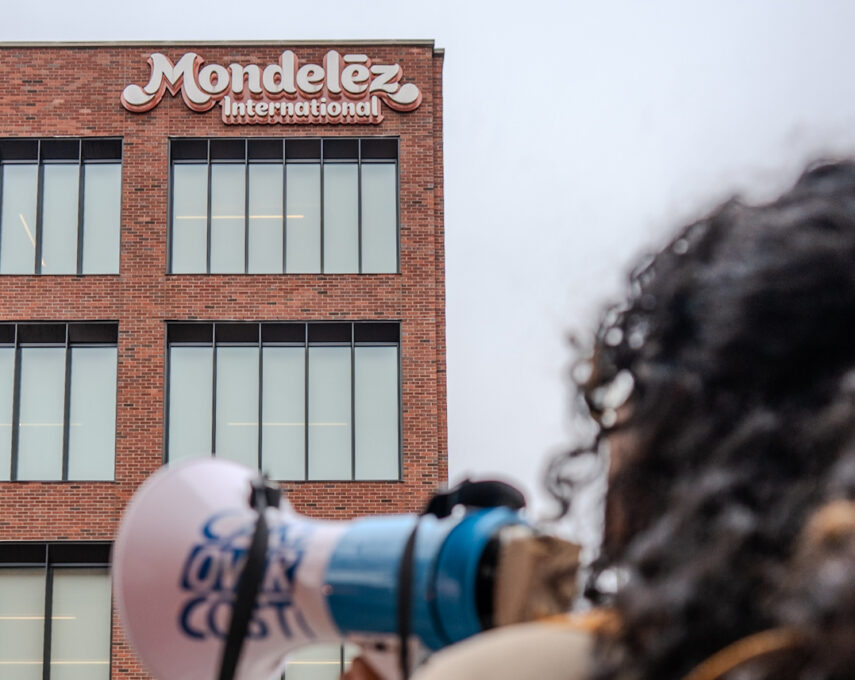
On National Oreo Day — March 6 — activists in more than a dozen cities gathered outside offices and facilities belonging to Mondelēz International, the $40 billion company behind Oreo, Ritz, and Chips Ahoy!, to protest the company’s palm oil supply chains.
The demonstrations stretched from New Jersey to California, drawing attention to the company’s links to ongoing deforestation in Indonesia’s Leuser Ecosystem — the last place on Earth where orangutans, elephants, tigers, and rhinos still coexist in the wild.
At the same time, thousands of people contacted Mondelēz directly online — sending messages to the company’s social media accounts and posting public feedback on its platforms — urging the company to address deforestation and human rights violations in its supply chains.
Oreo Day followed another recent flashpoint at a major investor event in Florida, where RAN activists interrupted CEO Dirk van de Put’s speech and demanded to know why the company continues to lag behind its competitors on deforestation and human rights. The CEO had no answer.
Mondelēz earned an F grade on RAN’s 2025 Brand Scorecard, ranking dead last in a cohort that includes ten major brands, including PepsiCo and Unilever.
In recent years, Mondelēz has doubled down on the status quo, and even had a hand in delaying the landmark European Union deforestation law, or EUDR, under the pretext that it would increase cocoa prices.
Besides its track record on deforestation, Mondelēz has also refused to adopt a policy to protect environmental defenders. In 2024, 146 environmental defenders were killed or disappeared worldwide — many in land conflicts tied to industries that feed commodity supply chains like those belonging to Mondelēz.
Mondelēz’ PR team calls their overarching corporate mission “Snacking Made Right.” On March 6, activists across the country called it all wrong.