Methane export terminals (LNG) threaten frontline communities and our shared climate. Investigative research has exposed the Big Insurance corporations backing these carbon bombs on the US Gulf Coast, the largest fossil fuel build out of our lifetimes.
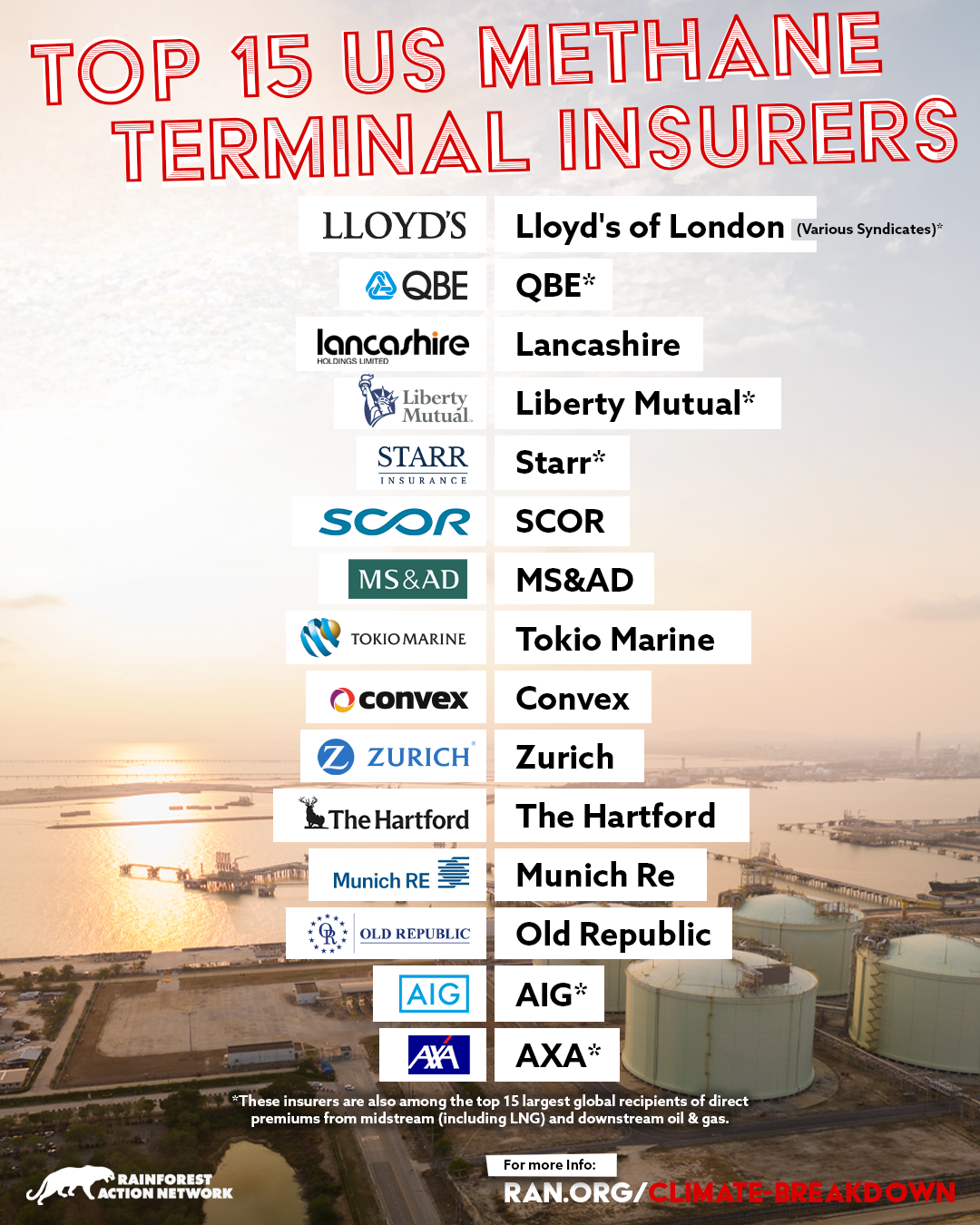
Insurance certificates and court filings obtained via public records requests reveal the top insurers backing twelve existing and proposed US methane terminals (see notes for methodology). Some of these initial findings were first published in Risk Exposure in 2024 and later updated in 2025 with Sacrifice Zones.
Notes
- Chubb fell from the top 15 to 16th after dropping its policy with Rio Grande LNG in 2024 and no longer holding a policy with Calcasieu Pass LNG as of March 2025.
- Information on insurance policies were collected through Certificates of Insurance obtained via public records requests on twelve existing and proposed methane terminals located in the United States. Rankings are based on the number of underwriting policies held as of March 14, 2026. Previously-verified terminal underwriting was used to determine rankings in the event of a tie. These certificates disclosed differing levels of detail about insurance policies. This list should be seen as a sample view of important insurers of these projects, but not a complete picture due to potential undisclosed information.
- The twelve operating and proposed US methane export terminals reviewed are as follows; Calcasieu Pass LNG, Cameron LNG, Rio Grande LNG, Freeport LNG, Texas LNG, Gulf LNG, Sabine Pass LNG, Magnolia LNG, Woodside LNG, Lake Charles LNG, Southern LNG, and Tacoma LNG.
- While this analysis focuses on underwriting it is important to note that some insurers are increasingly playing large roles as financiers. For example, AIG and Allianz are acting as major financiers for Rio Grande LNG and Allianz holds a significant indirect stake (15.1% common equity) in Venture Global (Calcasieu Pass LNG) through its subsidiary PIMCO.