On January 5, Brazil’s soy industry association ABIOVE, which represents major grain traders — Cargill, ADM, Bunge, Louis Dreyfus, COFCO and Amaggi — formally withdrew from the Amazon Soy Moratorium (ASM). The move followed years of intensive lobbying, and was triggered by the removal of tax incentives in the state of Mato Grosso for traders upholding the moratorium, which came into effect on January 1, 2026.
The ASM is a voluntary agreement under which signatory companies commit not to purchase soy grown on land deforested after July 2008 in the Amazon biome. It has been widely recognised as one of the most effective large-scale conservation efforts ever — decoupling soy expansion from deforestation. Between 2009 and 2022, deforestation fell by 69% in monitored municipalities while the planted area grew by 344%. Today, only 3.4% of the soy produced in the Amazon biome is outside the rules of the agreement, an essential differentiator for access to sustainability-conscious markets like the European Union.
The consequences of traders walking out of the ASM are huge. A preliminary study by IPAM indicates that if the ASM collapses, Amazon deforestation could surge 30% by 2045, putting millions of hectares at risk and directly undermining Brazil’s climate commitments. Scientists have warned that the Amazon is approaching a tipping point where the entire ecosystem could collapse into a fire-prone savannah, releasing billions of tonnes of carbon into the atmosphere.
SIGN THE PETITION: SAVE THE ASM!
However, the ASM collapse isn’t happening in isolation. It converges with two other critical policy shifts driven by aggressive lobbying by agribusiness and other industry groups. The delay and weakening of the EU Deforestation Regulation (EUDR), and the EU-Mercosur trade agreement that will expand Brazilian agricultural exports to Europe. Together, these create a perfect storm — opening markets and intensifying production pressure as safeguards are being dismantled and verification systems collapse.
Brazil is the world’s largest soy producer and exporter. In 2023, it produced approximately 152 million tonnes of soy and exported over 80%, representing 16% of Brazil’s total exports. According to Trase data, the six ABIOVE traders withdrawing from the ASM control over half of Brazilian soy exports. The primary markets are China (43% of exports), the EU (16%), and Singapore (6%).
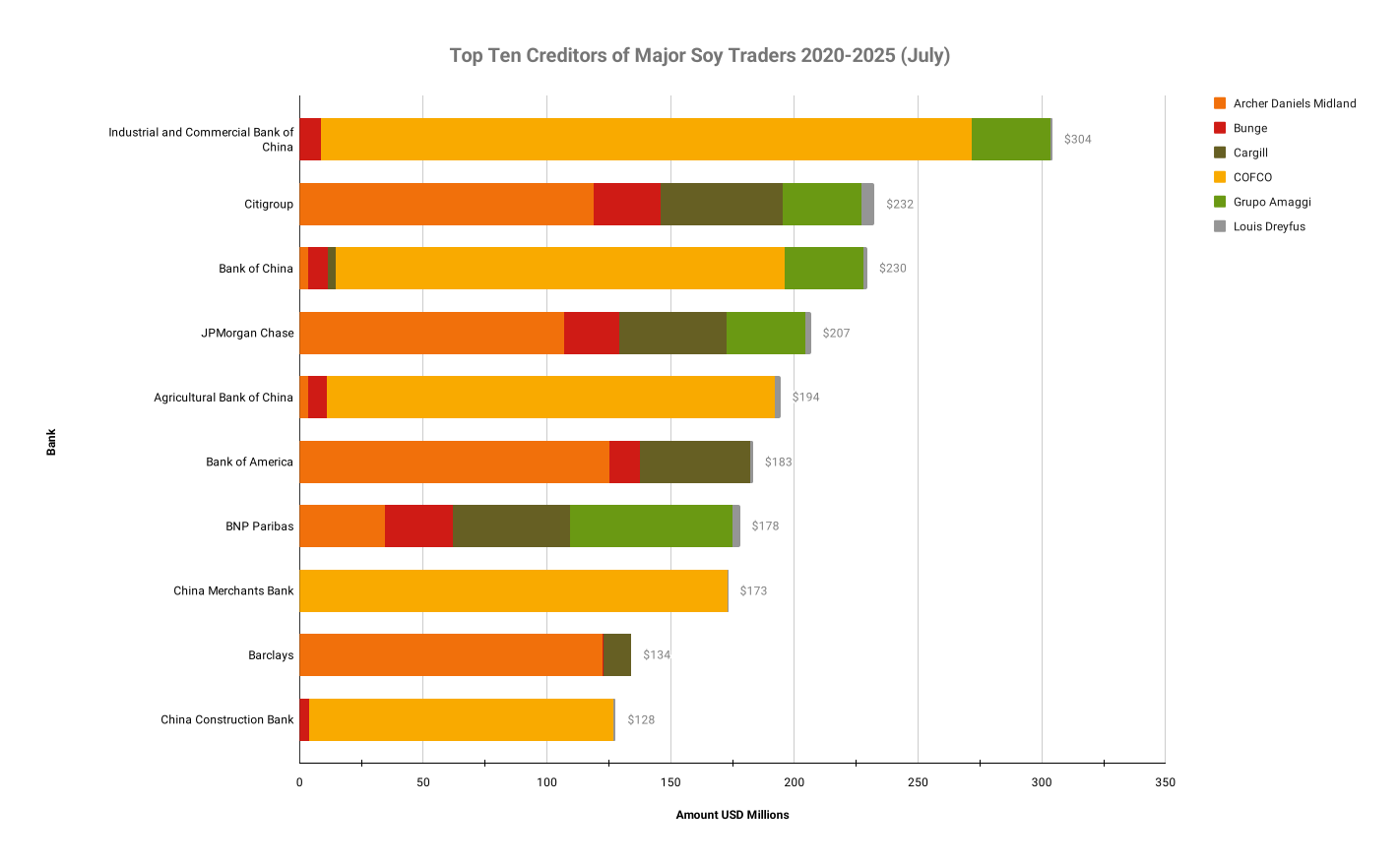
According to Forests & Finance data, the financial exposure to Brazil’s soy sector is massive with banks providing USD 75 billion in loans and underwriting between January 2020 and July 2025. The top creditors to the six major soy traders’ Brazilian operations include Citi, Bank of America, BNP Paribas, Barclays and five Chinese banks. For these financial institutions, the coordinated retreat from the ASM and effective forest protections creates material risks across billions in financial portfolios.
The ASM has enabled companies to confidently purchase soy from Brazil which was verified and part of the successful protection of the Amazon. Now, market risk is materialising as over a dozen major European supermarket chains including Lidl, Aldi and Tesco have written to traders to publicly reaffirm their commitment to the ASM. In July 2025, over 50 UK food companies, representing over 60% of the UK soy demand, reaffirmed their commitment to the ASM through the UK Soy Manifesto. Regulatory risk is building in anticipation of the EUDR enforcement which would restrict access to their second-largest market and penalise non-compliant companies.
Almost two decades of forest protection risk being wiped out if the ASM collapses and traders make further policy regressions. As recently as December 2025 — in anticipation of the ABIOVE announcement — COFCO and Bunge updated their policies. These updates removed any mention of their membership of the ASM or respect of the 2008 cut-off date. Instead, COFCO has moved its cut-off date to 31 December 2025, erasing 17 years of Amazon protection.
Many of the downstream companies exposed to soy have a deforestation commitment which relies on the ASM as a trusted implementation mechanism. CSOs shared a letter with major financial institutions in February, demanding they show leadership at this time by requiring clients operating in the Brazilian soy sector to uphold and maintain compliance with the criteria of the ASM. They should restrict financial services to traders which publicly reaffirm the 2008 cut-off date, farm-level traceability and the rejection of both legal and illegal deforestation in the Amazon biome. Banks and investors with leverage throughout the soy supply chain — from farmers, traders, manufacturers, and retailers — can play a crucial role in maintaining the integrity of the sustainable soy market to continue to protect the Amazon.