Legislation, regulations needed to hold U.S. insurance companies accountable for profiting from the affordability crisis driven by financing fossil fuel
In a just-released insider memo, senior insurance executives have confirmed what climate and consumer protection advocates have long warned: The property insurance industry is executing a deliberate strategy to shift climate risks and costs onto families, businesses, governments, and communities.
The memo, released by Inside Track with one of the risk assessors writing for The Guardian, shows insurance insiders admitting that they are deepening the affordability crisis by restricting, repricing, and withdrawing coverage ahead of major climate impacts, with little warning to the public.
“Our industry thrives in environments where risks are relatively predictable,” the group says. “We are moving into a world that is far from predictable, and we are neither prepared ourselves nor moving to prepare our customers of today, who may suddenly find that they are not our customers tomorrow.”
“Even if we reject any broader moral responsibility, we have a self-interest in not just pricing and timing risk but in helping to reduce it – something that is within our power and yet off our agenda,” the insider memo says.
Rainforest Action Network, Green America, and Stop the Money Pipeline have long warned that the property insurance industry’s practices of raising rates, not renewing policies, and not paying claims are making climate-vulnerable communities in the United States uninsurable – and the risk is rapidly spreading nationwide.
Particularly troubling is that most large U.S. insurers continue to insure fossil fuel projects and invest billions of dollars in the fossil fuel industry that is driving the extreme weather and climate impacts battering our communities.
The insurance insiders memo shows that the industry’s strategy is to limit or withdraw coverage ahead of major climate crises so that the cost will fall onto families, communities, and government – and if industry fails to withdraw coverage in time, insurers and their investors could face major financial risk, which could damage the entire economy.
Meanwhile, major U.S. property insurers — State Farm, Allstate, Liberty Mutual, Travelers, Chubb, and Berkshire Hathaway (parent of GEICO) — are investing billions of dollars into the stocks and bonds of fossil fuel companies driving the climate crisis. According to industry investment data from 205, fossil fuel investments by major U.S. insurance companies include:
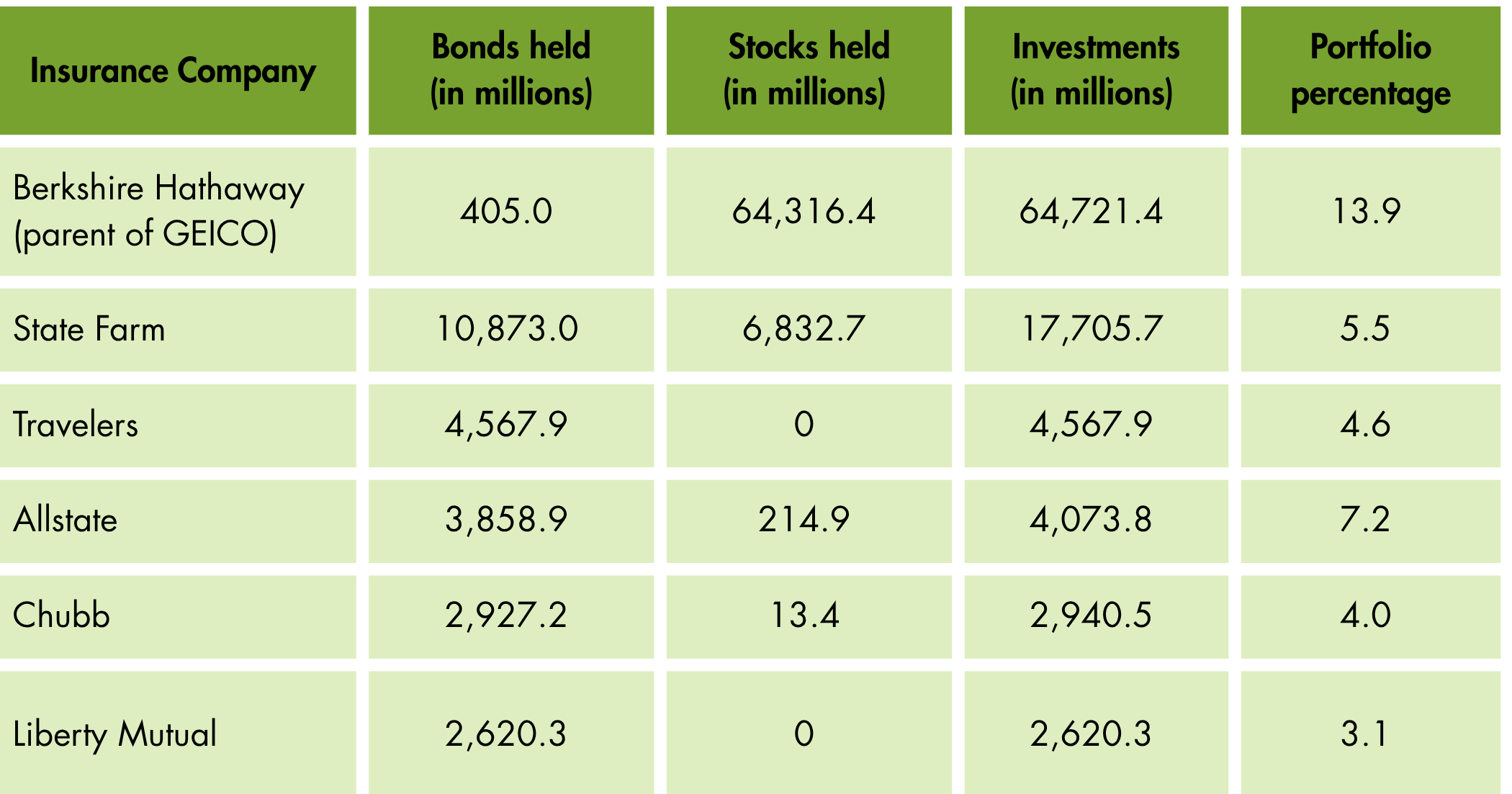
Meanwhile, a report by Rainforest Action Network and Public Citizen found that major companies insuring Liquefied Natural Gas (LNG) export terminals in the Gulf South include Liberty Mutual, Chubb, Travelers, and their subsidiaries. Likewise, bid documents show that major insurance companies underwriting fracking on state parks and public lands in Appalachian Ohio include Liberty Mutual, Chubb, Travelers, and their subsidiaries.
Extreme weather and climate events are extremely expensive. Data from the National Oceanic and Atmospheric Administration and Climate Central show that 208 wildfires, hurricanes, tornadoes, severe storms, flooding, drought, freezing, and winter storms over the past 10 years have cost $1.6 trillion and resulted in 6,568 deaths. These impacts will only worsen as U.S. energy policy continues to prioritize burning fossil fuels over clean and renewable energy.
“Insurance is necessary to access a mortgage, allowing providers to manage their own financial exposure,” the memo says. “As both domestic and commercial property insurance is limited or withdrawn at a significant scale, we foresee an economic risk that could precede a financial crash in the way that the sub-prime mortgage crisis catalyzed the Global Financial Crisis.”
Immediate legislation and regulations are needed to hold U.S. insurers accountable and prevent extreme climate costs from being pushed onto families and communities. Fortunately, several states are considering important initiatives that will be introduced in 2027.
For example, the New York Insure Our Communities Act would prohibit state-regulated insurers from insuring new fossil fuel projects. Insurers would be required to divest from fossil fuel companies and instead invest in under-resourced communities. They would also be banned from canceling coverage for at least one year after a climate disaster and required to disclose information such as rates, policy actions, and coverage data by census tract. California, Connecticut, and Oregon are introducing legislation with similar provisions.
Laws like the Insure Our Communities Act must be passed across the United States, so property insurance companies that families and communities pay to cover us during a disaster cannot instead underwrite and invest in the very industry at the root of this climate crisis.
New laws and regulations must ensure that polluters – who have known for decades that burning fossil fuels would cause climate disasters – are the ones who pay for families and communities to rebuild. Governments must lead the transition to a clean energy economy that protects the natural world on which life depends, rather than fossil fuels that tear it apart.
In response to the insurance insiders memo, members of the Insure Our Communities coalition made the following statements:
“This revelatory memo exposes that big U.S. insurance companies are making record profits while squeezing hardworking families already feeling the pain of high prices. State Farm, Liberty Mutual and their Big Oil buddies need to be held accountable and pay their fair share instead of fueling the crisis,” said Ethan Nuss, senior campaigner at Rainforest Action Network.
“Insurance executives just put in writing what New Yorkers have been telling us for months: their rates are spiking, their policies are disappearing, and nobody warned them. Our elected officials must protect people by holding polluters and their backers responsible,” said Liv Senghor, New York Campaigns Manager for Stop the Money Pipeline. “Bills like the Insure Our Communities Act in New York would bar insurers from covering new fossil fuel projects and require them to move their investments into underresourced communities. They would also be banned from canceling coverage for at least one year after a climate disaster and required to disclose information such as rates, policy actions, and coverage data by census tract. Every state needs laws like this.”
“This insurance insiders memo reveals what we have long suspected: That Big Insurance is prioritizing short-term profits over the stability of our climate and well-being of our communities. Fortunately some industry leaders are now speaking out about this abdication of responsibility. Climate change is a systemic risk to the entire economy, including the insurance industry itself. This industry is part of the problem now, but it could become part of the solution by insuring and investing in the clean energy transition instead of fossil fuels. It’s time for them to do the right thing,” said Cathy Becker, responsible finance campaign director at Green America.
###
About Rainforest Action Network: The Rainforest Action Network campaigns for the forests, their inhabitants, and the natural systems that sustain life by transforming the global marketplace through education, and grassroots organizing.
About Stop the Money Pipeline: Stop the Money Pipeline is a coalition of over 100 groups and organizations working to fight fossil fuels, end environmental racism, and defend the universal right to a safe, liveable planet. We launch high-impact campaigns that directly challenge billionaires and corporate giants driving global climate chaos and fueling the rise of authoritarianism. https://stopthemoneypipeline.org/
About Green America: Green America is the nation’s leading green economy organization. Founded in 1982, Green America provides the economic strategies, organizing power and practical tools for businesses and individuals to solve today’s social and environmental problems. http://www.GreenAmerica.org