Key Findings
- Tokio Marine is violating its own Code of Conduct and Human Rights policies
- Insuring Venture Global exposes Tokio Marine to significant legal, financial, and reputational risks
- Research suggests if Tokio Marine’s complied with its own policies, it could decrease its risk exposure, remedy the harm caused in this case, and help shift the entire industry away from projects that degrade human rights and the environment
Stakeholders in Louisiana and Japan filed a comprehensive human rights grievance against Tokio Marine Group based on documented harms of Venture Global’s Calcasieu Pass 1 LNG concerning pollution and economic loss. It alleges the Japanese insurer (through its subsidiary, which holds 7.5% of a $900 million insurance policy for the methane terminal) violated its own policies and international human rights laws by providing coverage to Venture Global’s terminal in Louisiana. The grievance argues that Venture Global’s conduct and Tokio Marine’s knowing complicity have led to an emergent ecological and human rights crisis and reflect a clear and ongoing disregard for legal and ethical obligations.
This grievance comes after years-long attempts from stakeholders and representatives of the local communities, warning the major Japanese insurer about reputational, human rights, and financial risks of fossil fuels and LNG underwriting. Tokio Marine has a documented history of non-compliance with its own Code of Conduct, Human Rights Policy, and international human rights frameworks through its exposure to Venture Global. Tokio Marine’s provision of insurance to Venture Global materially supports Venture Global’s operations in Louisiana by acting as a financial safety net against catastrophic losses and reducing associated risks. Tokio Marine’s continued business relationship with Venture Global exposes the company to significant legal and reputational risks and undermines Tokio Marine’s stated commitment to human rights.
The complaint, submitted through Tokio Marine’s Global Stakeholders Hotline, argues Tokio Marine violated multiple provisions of its own Human Rights Policy, which requires due diligence before engaging with clients, direct management engagement with impacted communities, compliance with domestic and international laws and re-assessment of risks throughout business relationships. Insurance coverage was provided despite findings that the facility was out of legal compliance with the Clean Air Act for over 50% of its operating time and is currently subject to multiple federal lawsuits challenging its Clean Air Act permits and state operational licenses.
Human Rights Impacts from CP2 Dredging Disaster
The grievance details economic harm regarding a catastrophic August 2025 disaster where a dredging project associated with Venture Global’s CP2 construction project spilled tons of sediment into fishing waters, smothering crucial oyster beds in thick sludge as shrimp season opened. Shrimpers shared on social media their empty, muddy nets and oysterfolk blame the disaster for killing their catch and destroying their income months after the disaster. This is a violation of rights enshrined in Article 25 of the Universal Declaration of Human Rights that specifically protects standard of living against loss of livelihood.
“This disaster was entirely preventable and represents exactly the kind of harm that Tokio Marine’s own human rights policies are supposed to prevent.” – Solomon Williams, Jr. from the Fisherfamily Advisory Council for Tradition & Stewardship (FACTS), an oyster fisherman and one of the complaint’s signatories.
Additionally, a public records request recently revealed that a Tokio Marine subsidiary is also a primary insurance provider for Callen Marine Ltd, the operator contracted by Venture Global in charge of important aspects of the dredging when the spill occurred. Tokio Marine’s subsidiaries—US Specialty Insurance (USI) owned by Tokio Marine HCC—holds three key policies with Callen Marine Ltd: $2M Marine General Liability policy, $5M P&I policy (Protection and Indemnity), and a $10M Excess Liability policy from July 1, 2025-2026, covering the time when the disaster occurred.
Tokio Marine Violates Human Rights Frameworks
The grievance outlines the violation of numerous international human rights frameworks that Tokio Marine purports to uphold. Here are a few highlights:
- Right to Adequate Standard of Living (Resulting From Loss of Livelihood)
- Article 25 of the Universal Declaration of Human Rights
- Article 11 of the International Covenant on Economic, Social and Cultural Rights
- The Right to Safe and Dignified Working Conditions
- Article 23 and 3 of the Universal Declaration of Human Rights
- Article 6 and 25 of the International Covenant on Economic, Social and Cultural Rights
- Principle 5 of the ILO Declaration on Fundamental Principles and Rights at Work
- Performance Standard 2 of the International Finance Corporation’s (World Bank Group) Performance Standards on Environmental and Social Sustainability
- Right to Cultural Heritage
- Article 27 of the Universal Declaration of Human Rights
- Article 15 of the International Covenant on Economic, Social and Cultural Rights
- Performance Standards 7 and 8 of the International Finance Corporation’s (World Bank Group) Performance Standards on Environmental and Social Sustainability
- United Nations Declaration on the Rights of Indigenous Peoples
- Right to Health
- Article 12 of the International Covenant on Economic, Social and Cultural Rights,
- Article 26 of the International Covenant on Civil and Political Rights
- Performance Standard 4 of the International Finance Corporation’s (World Bank Group) Performance Standards on Environmental and Social Sustainability
- Right to Remedy
- Article 8 of the Universal Declaration of Human Rights,
- Article 2 of the International Covenant on Civil and Political Rights
- Principle 22 of the UN Guiding Principles on Business and Human Rights
The complaint warns that failure to act on these rights violations could result in additional complaints to the OECD Japanese National Contact Point. There is also precedent for grievances like these to trigger investigations by UN Special Procedures. The grievance includes a detailed timeline showing Tokio Marine was repeatedly warned about these risks in July of 2022 to most recently as September of 2025. Despite these warnings, Tokio Marine continued providing coverage. Its insurance policy for Calcesieu Pass 1 LNG is set to renew March 14, 2026.
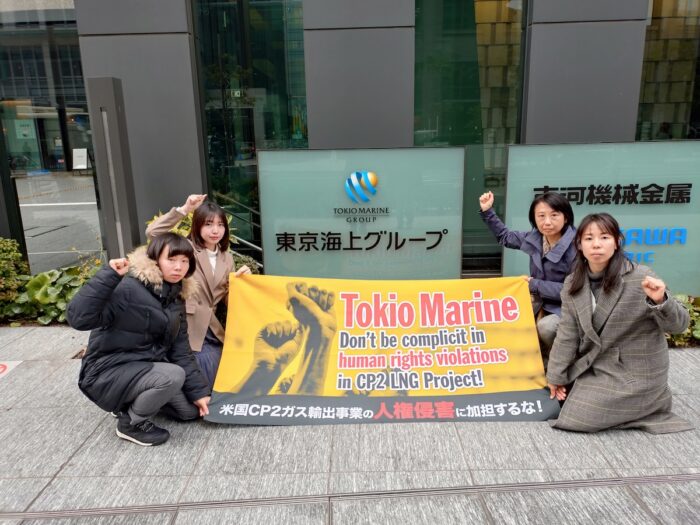
Impacted Community and Ally Demands for Tokio Marine
The organizations – For A Better Bayou, Fisherfamily Advisory Council for Tradition & Stewardship (FACTS) of the Habitat Recovery Project, Japan Center for a Sustainable Environment and Society (JACSES), and Rainforest Action Network are demanding that Tokio Marine:
- Deny coverage renewal for Venture Global’s Calcasieu Pass LNG when the policy expires March 14, 2026
- Rule out any future coverage for Venture Global’s expansion projects (CP2, CP3, Plaquemines LNG Phase II)
- Conduct full human rights due diligence, including in-person meetings between senior leadership and impacted communities
- Provide monetary remedies to affected fishing families and communities
- Launch internal investigation to hold accountable executives who approved non-compliant coverage
“Tokio Marine and SOMPO should immediately halt the renewal of their insurance support for the Calcasieu Pass LNG, and conduct appropriate human rights due diligence in accordance with their human rights policies regarding the human rights violations that occurred in the Venture Global accident.” – Yuki Tanabe, the of Program Director, JACSES.
A similar human rights complaint letter was also sent to SOMPO, a major Japanese non-life insurance company, insuring Venture Global. Although SOMPO does not have a publicly available mechanism like Tokio Marine’s Global Stakeholder Hotline, SOMPO states that “we have established a mechanism to broadly receive complaints, consultations, and opinions regarding human rights from diverse stakeholders and rights-holders.” Both SOMPO and Tokio Marine have an obligation to work with impacted communities who have a right to remedy as enshrined in Article 8 of the Universal Declaration of Human Rights. Other major insurers of Venture Global—like Allianz, AXA, SwissRe, SCOR, Aviva, MunichRe, and Zurich—could risk similar human rights complaints if they fail to proactively adhere to their human rights due diligence processes.
Tokio Marine reportedly received $430 million from direct fossil fuel premiums in 2023- 2024. The company’s North America operations have outperformed other regions, suggesting Tokio Marine facilitated and profited from these ongoing human rights harms. Academic research cited in the complaint demonstrates that when insurers adhere to their underwriting policies, it creates market conditions that directly constrain harmful operations more broadly. This means that Tokio Marine’s compliance with its own policies could decrease its risk exposure, remedy the harm caused in this case, and help shift the entire industry away from projects that degrade human rights and the environment.
Grievance Outline
Below is an outline for the 20 page grievance which can be read here.
I. Infringements of Human Rights Policies and Laws
A. Tokio Marine’s Infringements of its Own Human Rights Policy
B. Relevant International Human Rights Law and Frameworks
II. Human Rights Abuses Caused by Venture Global with Material Support from Tokio Marine
A. Recent Case Study: Venture Global’s CP2 Construction Disaster
B. Loss of Livelihood and Standard of Living
C. The Right to Safe and Dignified Working Conditions
D. Right to Cultural Heritage
E. Right to Health
III. Tokio Marine’s Culpability and Responsibility to Remedy Harm
A. Culpability: Tokio Marine Facilitated and Profited From These Human Rights Harms
B. Disregard for Risks: Efforts to Raise Human Rights Concerns with Tokio Marine
C. Right to Remedy
D. Tokio Marine’s Responsibility and Consequences
E. Course of Action to Remedy Human Rights Harms