Key Findings
- The Santa Marta conference marked the first-ever country-level talks focused on pathways for transitioning away from fossil fuels — a significant milestone in the global effort to phase down and out of coal, oil, and gas.
- To bring finance more fully into the fossil fuel phaseout debate, RAN and partners elevated a critical message: there can be no credible transition away from fossil fuels without confronting the public and private financial systems that continue to enable their expansion.
- The Financing a Fossil-Free Future policy brief lays out a roadmap for aligning public finance, private finance, insurance, financial regulation, and central bank policy with a just and managed fossil fuel phaseout.
- RAN worked with BankTrack, Stand.earth, Urgewald, Amazon Watch, Friends of the Earth U.S., ReCommon, Indigenous leaders, and parliamentarians to move the finance agenda into the public narrative, policy discussions, and conference outcomes.
- Santa Marta was not the finish line. With a follow-up conference announced for 2027 in Tuvalu and the COP30 Roadmap for Transitioning Away from Fossil Fuels underway, the work now is to turn momentum into durable financial rules, safeguards, and implementation pathways.
Last week in Santa Marta, Colombia, the world took a meaningful step towards ending its fossil fuel dependency.
The first-ever country-level talks on pathways for transitioning away from fossil fuels brought together ministers and envoys from 57 countries, alongside regional governments, civil society leaders, Indigenous Peoples, and scientists. Convened amid the second major fossil fuel crisis in five years, the conference reflected deepening global recognition that fossil fuels are not only driving climate breakdown — they are also a source of economic volatility, geopolitical instability, and grievous health and rights harms.
The signal from Santa Marta was clear: momentum is building to phase out fossil fuels and usher in a managed transition to a just clean energy future. Just as importantly, the talks ended not with a one-off declaration, but with a commitment to continue — including a follow-up conference already announced for 2027 in Tuvalu.
But there can be no transitioning away from coal, oil and gas unless we confront how entangled the global financial system, both public and private sector finance, has become with fossil fuels. The full set of barriers and levers to accelerate the energy transition across the financial system are too often overlooked when naming climate solutions and crafting implementation strategies for country and regional governments or institutions to follow.

A Strategy For Elevating Private And Public Financial Roadmaps For Fossil Phase Out
To ensure history didn’t repeat itself, RAN and several partners enacted a multi-prong strategy to elevate the necessity of addressing financial pathways for halting the expansion of new fossil fuels and accelerating the phase down and out of all fossil fuels in the public narrative and the policy recommendations of the Santa Marta conference. These prongs included:
- A policy brief: Financing a Fossil-Free Future: A Roadmap for Realigning Public and Private Finance with a Just and Managed Fossil Fuel Phase Out
- A pre-conference webinar (Passcode: uZ7mgi#0)
- An on-the-ground event in Santa Marta
- A formal submission to the Santa Marta conference
- And the simultaneous submission of the policy paper to the COP30 Presidency’s Roadmap for Transitioning Away from Fossil Fuels.
On each of these pieces and at every step of the process RAN worked closely with partners. We worked with campaigning finance orgs like BankTrack and Stand.Earth to amass and align our voices behind a unified strategy to articulate the public and private sector financial architecture and reforms needed to deliver a fast, fair, funded and durable global phase down and out of fossil fuels. RAN coordinated closely with Amazon Watch and other Indigenous-centered organizations to award a $15,000 USD community action grant, allocated between an Indigenous delegation from Ecuador, Peru, and Colombia and a delegation coordinated by the UN Permanent Forum on Indigenous Issues. And we worked with the Parliamentarians for a Fossil Free Future to deliver our recommendations to attentive and aligned lawmakers positioned to carry our messages into high-level discussions.
A Policy Roadmap For Realigning Public And Private Finance
The policy brief, developed by RAN in collaboration with BankTrack, Stand.Earth, Urgewald, Amazon Watch, FOE US, and Recommon examines how financing enables expansion at every stage, from public subsidies to private capital and insurance. It identifies systemic drivers that enable continued fossil fuel financing and sets out policy recommendations for financial sector reforms across regulation of private finance, government policies to reduce public financing of fossil fuels, and alignment with Paris Agreement goals, human rights standards and ecological integrity. These recommendations focus on three key areas:
- Urging legislators, regulators, and central bank authorities to enact macroprudential, monetary policy, and financial regulatory reforms, such as requiring comprehensive disclosures of climate risk and obust climate stress testing; mandating transition plans from financial institutions and integrating climate and biodiversity risks into prudential requirements like capital buffers and liquidity requirements; Extend oversight to private-equity and other creditors; and enhancing transparency and regulatory oversight of credit rating methodologies.
- Calling on governments to pass policies to reduce public incentives for fossil fuels, such as phasing out fossil fuel subsidies and tax exemptions; ending financial support to fossil fuels through MDB, bilateral development finance, and export credit agency channels; and signing onto clean energy partnerships among other suggested policies.
- Cautioning that finance must align with just transition principles of human rights, ecological integrity, and accountability and be accompanied by legal-binding safeguards that protect human rights, forests, and ecological integrity in order not to reproduce extractive harms.
Read Financing A Fossil-Free Future for more details on each of the above.
Promoting The Policy Brief
RAN and its partners took several steps to share the policy brief with key audiences heading into the Santa Marta conference. RAN and many of the contributing organizations to brief hosted a webinar. We also circulated the brief with the CAN-International and the Fossil Fuel Non-proliferation Treaty networks, both of whom were at the heart of organizing civil society participation and contributions at the talks. RAN also shared the brief with the Parliamentarians for a Fossil Free Future who distributed it to the Parl Fossil Free network of global lawmakers.
A Marque Event In Santa Marta: Financial Roadmaps Towards A Just Phaseout And A Fossil-Free Amazon
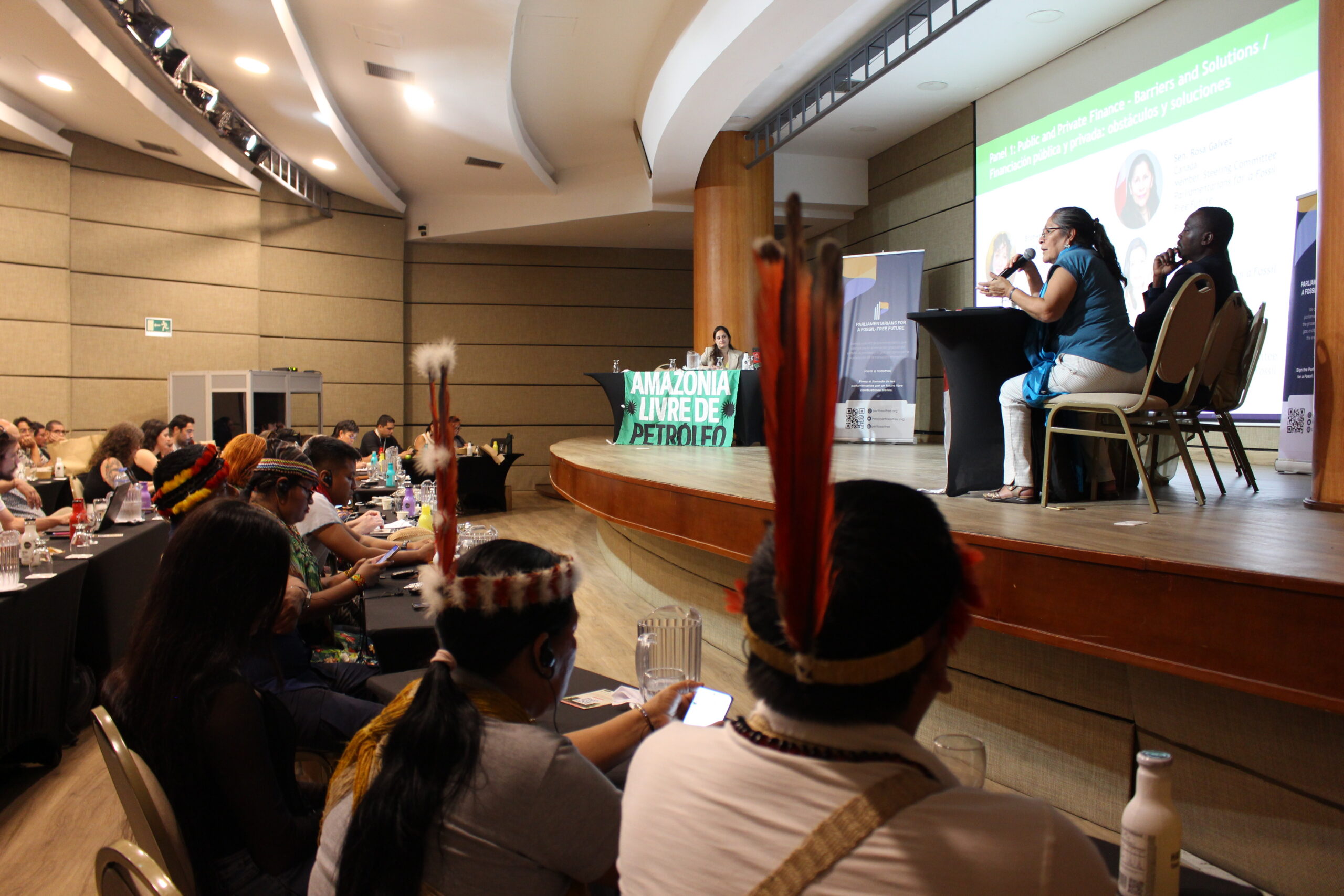
To raise the visibility of the brief on the ground in Santa Marta, RAN and eight partners hosted a marque event to highlight Financial Roadmaps towards a Just Phaseout and a Fossil-Free Amazon. The event became a focal point for discussions on the role that financial reform and regulation must play in delivering a just transition. It also centered the experiences of Amazonian Indigenous leaders and organizations leading campaigns to halt oil and gas expansion and fossil financing that threatens their territories.
Held on the first day of the high-level segment, the event was strategically timed to maximize the visibility of the policy brief and its recommendations for inclusion in high-level discussions shaping the conference’s preliminary report and ultimate co-chairs’ summary expected towards the end of May.
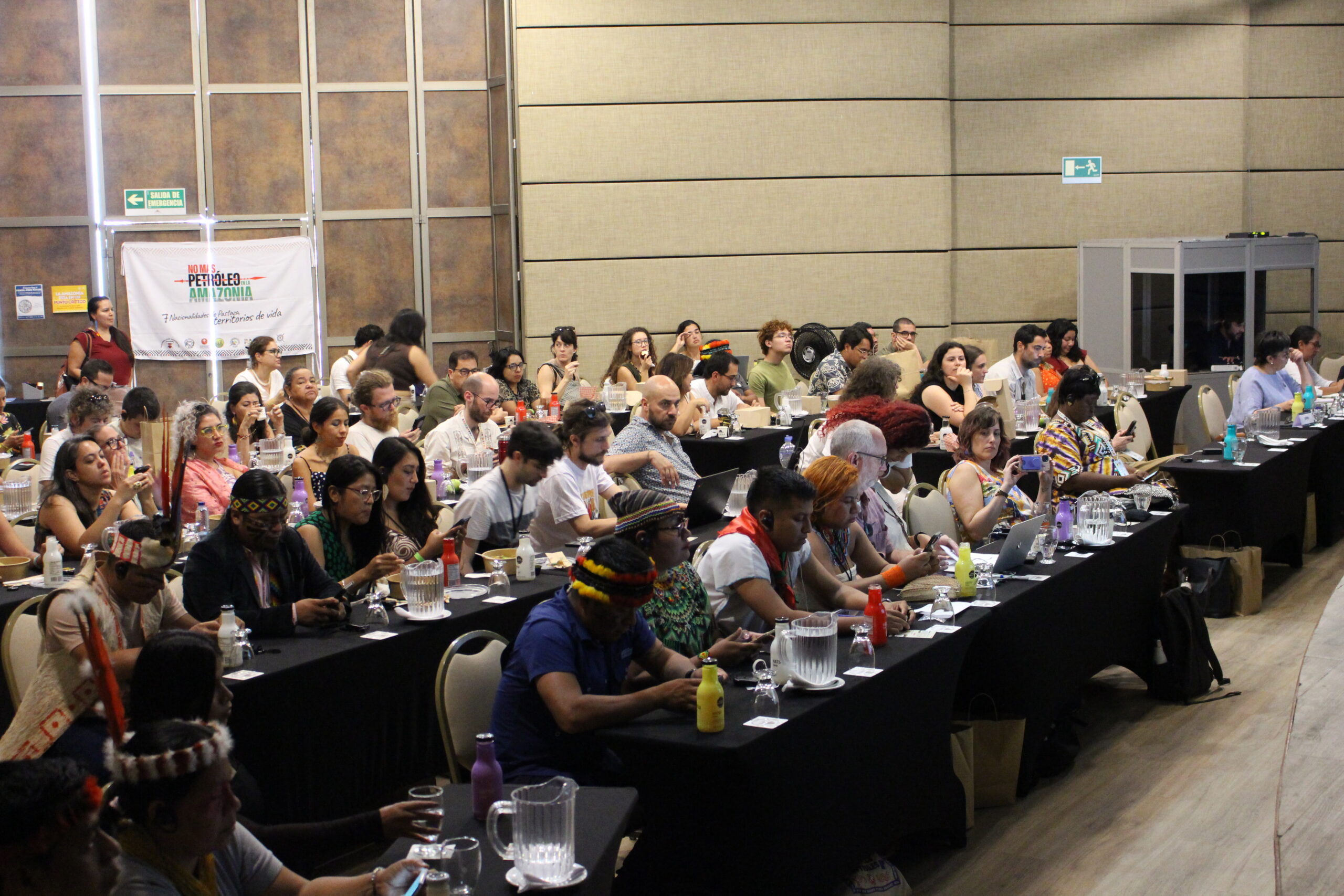
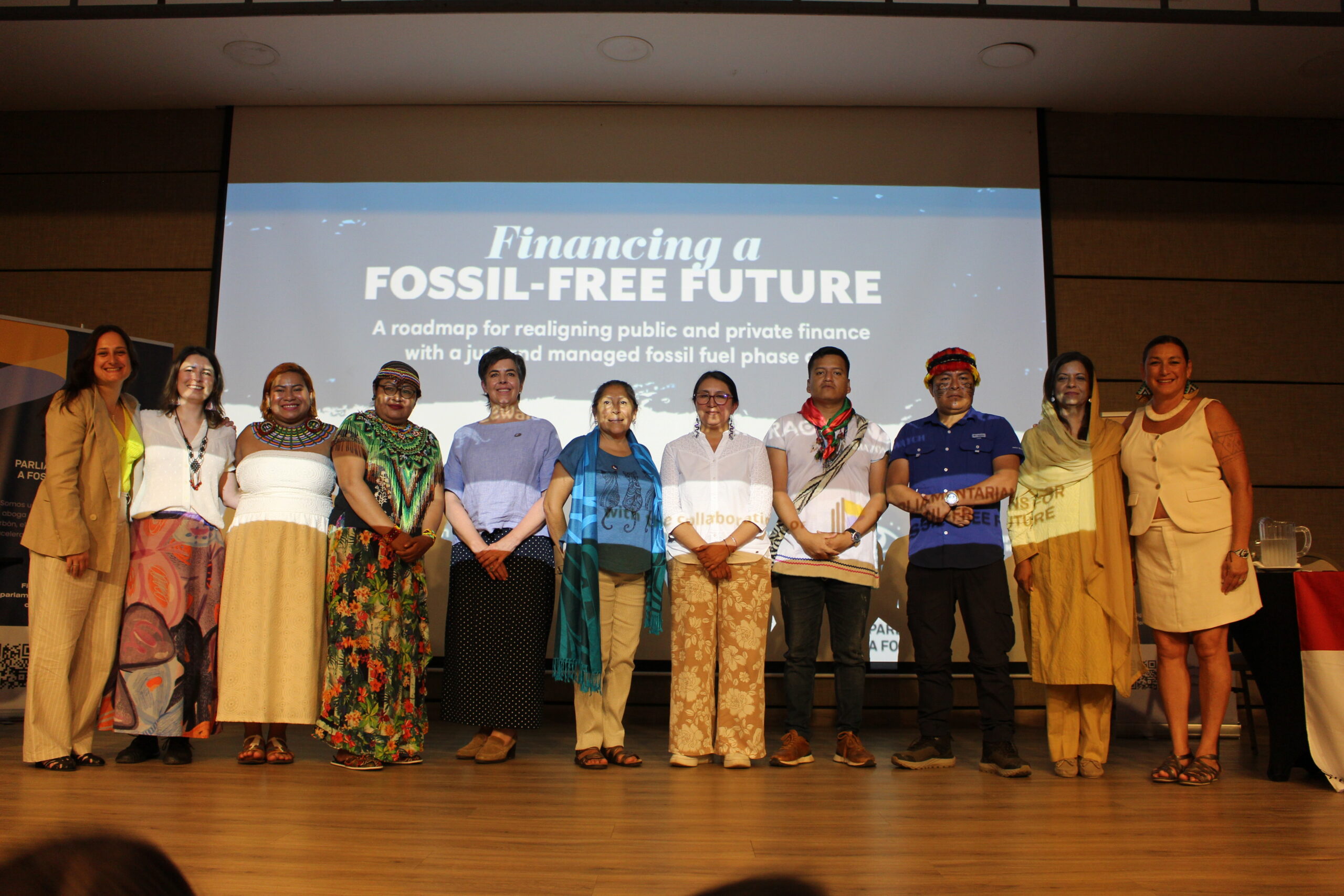
At the Santa Marta event, parliamentary lawmakers delivered remarks side-by-side with Amazonian Indigenous leaders and NGO representatives. Drawing a crowd of an estimated 80 or 90 attendees, the audience filled the room. The full speaker line up included six members of parliament, four NGO representatives, and four Indigenous leaders from across the Amazon basin countries of Peru, Ecuador, Colombia, and Brazil representing groups located along the Amazon from its headwaters to the river’s mouth.
The event was opened by Juan Carlos Lozada, MP for Colombia and Steering Committee Member of Parliamentarians for a Fossil Free Future and featured stirring testimonials from Olivia Bisa Tirko, the President of the Autonomous Territorial Government of the Chapra Nation (GTANCH) and Luene Karipuna, the Coordinadora Executiva, Articulação dos Povos e Organizações Indígenas do Amapá e Norte do Pará (APOIANP) among others.
Influencing The Summit Outcomes
While there is more work to do, there are clear signs that the signal we worked to send was received and incorporated into the outcomes of the conference, both in the People’s Summit Declaration and in the Co-Host Takeaways summary.
The People’s Summit Declaration named the “private sector [as] bear[ing] its share of responsibility for the transformation of energy systems to renewables,” listed a comprehensive spectrum of private sector actors “including commercial and private banks, insurers, private retirement funds, asset managers, private equity firms, and venture capital,” calling them out as “massive enablers of current fossil fuel production and usage and fossil fuel expansion,” and insisting that “private investments in energy systems must be regulated and directed to move away from fossil fuels towards a just transition.”
The preliminary Key Takeaways Report released by the Conference Co-Chairs went further including language consistent with the policy brief including naming “the dependence of the financial architecture on fossil fuels” as a key barrier and capturing that “participants identified aligning public and private finance with transition needs critical to enhance credible national transition plans and pipelines…and stressed the need for governments to provide clear and consistent direction for finance, better coordination with financial institutions.”
Of particular interest is this clause identifying “central banks as relevant actors for managing transition-related financial stability risks and avoiding higher capital costs for transition finance.” The degree of leverage that central banks have over whether the financial system will continue to incentivize fossil finance, accumulate dangerous levels of climate financial risk, and shield fossil financiers from accountability or, alternatively, is harnessed as an engine for accelerating transition planning and redirecting capital into clean energy is often omitted from the solution sets produced by major international conferences.
What Comes Next: Sustaining The Work Beyond Santa Marta
But Santa Marta is just one step in a longer trajectory of work. As previously mentioned RAN also submitted the financing the future policy paper to the ongoing COP30 Presidency’s Roadmap for Transitioning Away from Fossil Fuels. We will continue to advocate for its recommendations to be integrated into the implementation plans developed through that process.
RAN and its partners must also direct their work to influence the three workstreams established by the Santa Marta conference which will focus on “identifying concrete opportunities and channels for cooperation to overcome fossil fuel dependencies in preparation for the second conference.”
One of these three workstreams is dedicated to “work on macroeconomic dependencies and financial architecture” and names IISD as co-managers for this issue area. Currently the mandate of this workstream is to “look for the necessary expertise to help leverage collective capacities to support the necessary changes in financial systems, unlock finance and investment flows required for the transition, and determine who needs to be involved. This workstream will include a focus on debt constraints, as well as on financial incentives and subsidies.”
But RAN and its partners must push for this workstream to take a wider lens on financial architecture to include the banking sector and other private sector actors and needed state regulations for managing private sector risk.
One strategic avenue to accomplish this aim is suggested by the very last sentence in the Co-Host Takeaways document and may require forging a partnership with the “academic group on central banks that participated in [the Santa Marta] process.” This group has already announced “they will continue to engage in a Santa Marta Financial Stability Group to continue this open engagement.” RAN plans to track the formation of that body closely and look for opportunities to share its policy brief and central bank tailored recommendations with the group.