Banking on Climate Chaos (BOCC) began as a few-page coal report card. Today, it’s the world’s most comprehensive analysis of how the global banking system finances the climate crisis — providing the data that frontline communities, analysts, investors, regulators, and journalists rely on to hold that system to account.
Where it Started: a Coal Report Card
In 2010, a small team at Rainforest Action Network, BankTrack, and Sierra Club published the first Report Card on Banks and Mountaintop Removal — a letter-graded ranking of banks based on their lending and underwriting of mountaintop removal mining in Appalachia. The premise was simple and at the time radical: banks weren’t bystanders to the climate crisis. They were actively financing it. If the public could see how, pressure would build and banks would adopt policies to phase out such support.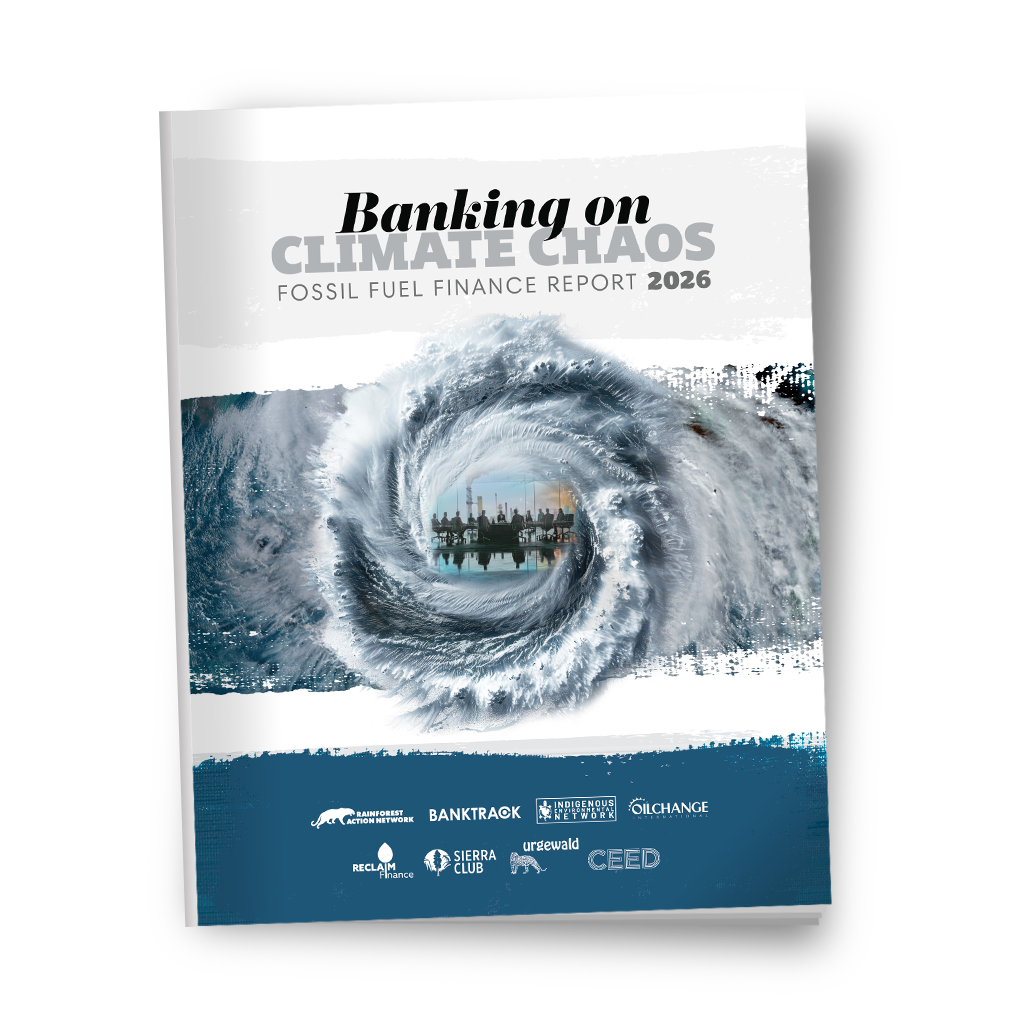
By 2014, the report had a new title — Extreme Investments, Extreme Consequences: Coal Finance Report Card — and expanded to focus on mountaintop removal, coal-fired power, coal transport and coal export. By then, bank-by-bank grades on mountaintop removal had become a fixture of shareholder meetings, divestment campaigns, and investigative reporting on Appalachia.
The data was already changing minds. Major Wall Street banks cut lending to coal mining worldwide and exited a contested coal export terminal. Several megabanks committed to end coal financing ahead of COP 21.
The pattern that would define the next decade was already in place: pressure plus public data plus persistent organizing produced movement, even from institutions that swore they wouldn’t or couldn’t move.
Meeting the Moment: from Coal to the Entire Fossil Fuel Value Chain
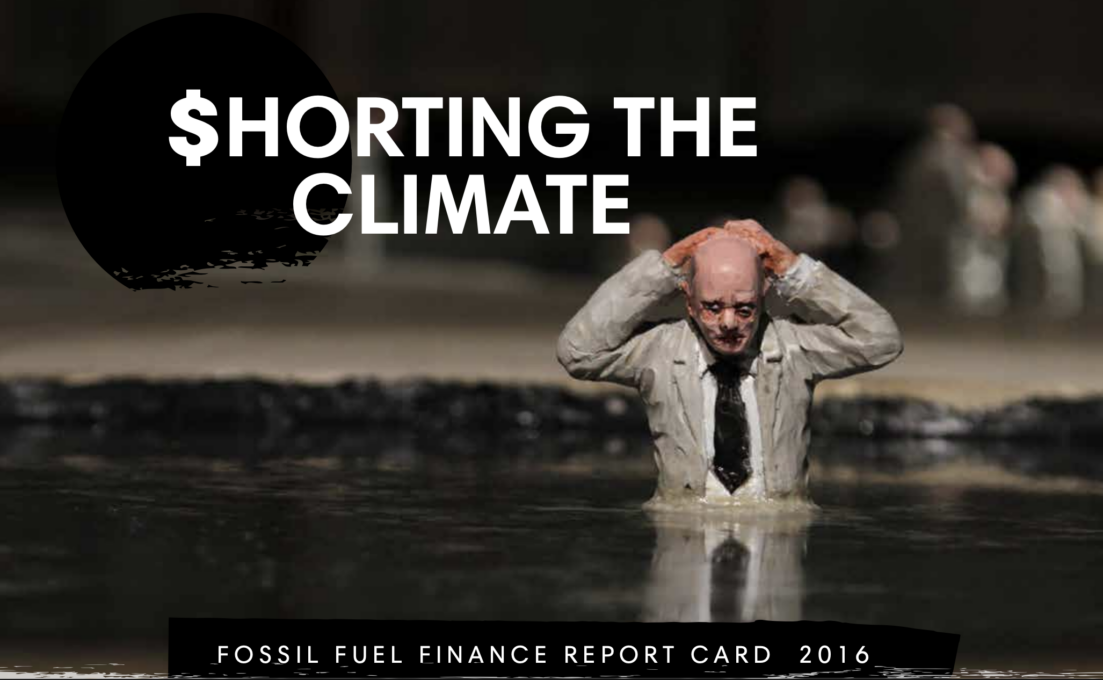
By the late 2010s the Coalition had grown and so had the scope. The 2016 edition — $horting the Climate — introduced extreme oil and fossil gas export financing for the first time into the bank rankings, and layered in Arctic drilling and Tar Sands financing. By 2018, Indigenous Environmental Network, Oil Change International, and later, Reclaim Finance joined the Coalition. In order to meet the scale of the climate crisis, the 2019 edition — the 10th edition — was the first to track lending and underwriting by 33 global banks across the entire fossil fuel sector of around 1,800 fossil fuel companies. The headline number that year — $1.9 trillion in fossil fuel finance since the Paris Agreement — was the most comprehensive datapoint yet of how the world’s top banks were fueling the climate crisis. By 2020, the bank sample had grown to 35 banks and the cumulative total had reached $2.7 trillion.
In 2021, the report took the name it carries today: Banking on Climate Chaos. The shift in title reflected a shift in stakes. Net-zero pledges from major banks were proliferating. The Net-Zero Banking Alliance launched ahead of COP26 in Glasgow. The political theater of climate commitment was at its peak — and the data showed an industry whose financing for fossil fuels was, in absolute terms, still rising. The 2021 edition expanded to 60 banks and reported a cumulative $3.8 trillion since 2016.
Each year since has refined the picture. Urgewald joined the Coalition in 2022, integrating the Global Coal Exit List and Global Oil & Gas Exit List into the methodology so that “expansion” companies could be tracked with consistent, global criteria. Center for Energy, Ecology, and Development (CEED) joined the coalition in 2023, bringing Southeast Asian research and frontline expertise.
In 2024, the Coalition introduced its largest methodological upgrade yet: the report now credits every bank participating in a deal, not just lead arrangers — a change that exposed previously invisible billions in fossil fuel financial flows. While still focusing on the world’s top 65 banks, the 2026 edition leveraged a new BOCC+ dataset of 1,900 banks across the fossil fuel value chain of almost three thousand companies worldwide — the most comprehensive footprint of fossil fuel finance to date, including corporate financing as well as project financing, and lending and capital market transactions financed by banks.
The arc of the work in brief: from one fuel and a handful of banks to the entire fossil value chain across 1,900 financial institutions, in a coalition spanning Indigenous, frontline, and finance-research expertise.
The Impact: BOCC’s Ongoing Influence
For a project that began with a couple laptops and creative brainstorming, the BOCC report has shaped the climate finance conversation in a variety of ways.
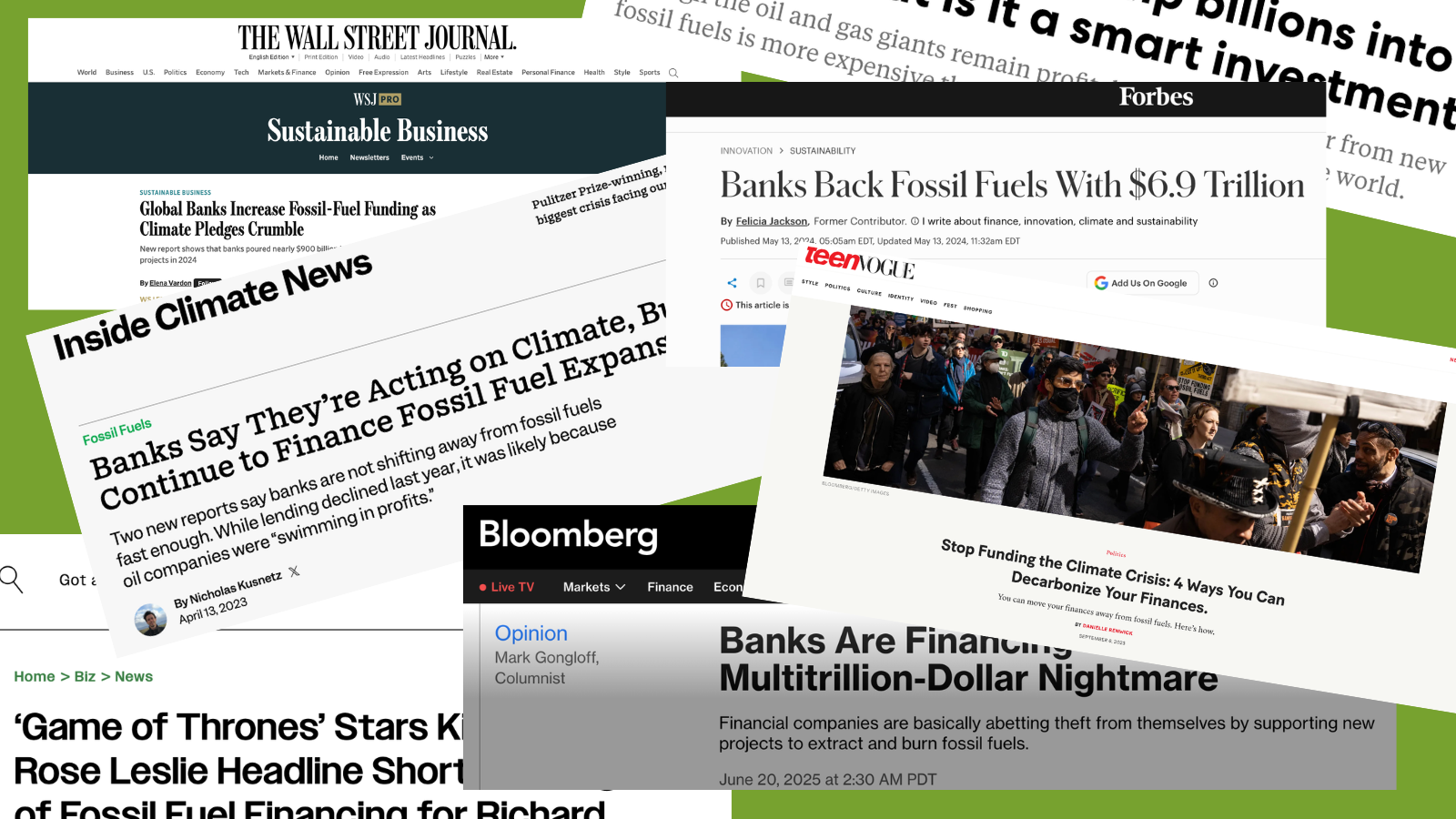
BOCC has helped shape narratives and put bank financing on the climate map. Before the BOCC reports, “climate” and “banking” were rarely uttered in the same sentence by the mainstream financial press. Today, the report is referenced annually by the Financial Times, The Guardian, Bloomberg, the American Banker and outlets in dozens of languages.
-
- In 2025, The Wall Street Journal covered RAN’s Banking On Climate Chaos report, framing the impact and risk of financing fossil fuels for financial institutions just as bank financing for fossil fuels increased collectively for the first time in three years.
- This prominent article also uses the term “methane” when describing the oil and gas buildout — a much needed narrative shift away from the misleading greenwash term “liquified natural gas.”
- The 2025 report was covered in more than 300 articles across 30+ countries in its first week — from France and Germany to Japan, Nigeria, India, Singapore, and Vietnam. Its release has become a fixture of the global climate news calendar.
BOCC provides the data that campaigners and frontline communities use to influence change globally. The report’s bank-by-bank, sector-by-sector league tables and analysis are not just a publication — they are a tool for leverage.
-
- The data has anchored university divestment and bank pressure campaigns across three continents.
- Faith groups have also relied on BOCC to call for action on banks.
- The BOCC data is also being used by campaigners to spotlight financing trends in Asia and Latin America.
- Indonesian civil society organizations often use the report — and coverage by outlets like Kompas, Tempo, Mongabay Indonesia, and CNN Indonesia — to amplify calls for banking reform or highlight the urgency of financial regulation.
- In Latin America, partners published a report ahead of COP 30 on fossil fuel expansion using BOCC data.
- Hundreds of organizations from every continent endorse the BOCC demand set each year.
- BOCC researchers conduct annual training on the report’s findings and data with campaigners in Asia, Africa, Latin America, Europe, and North America.
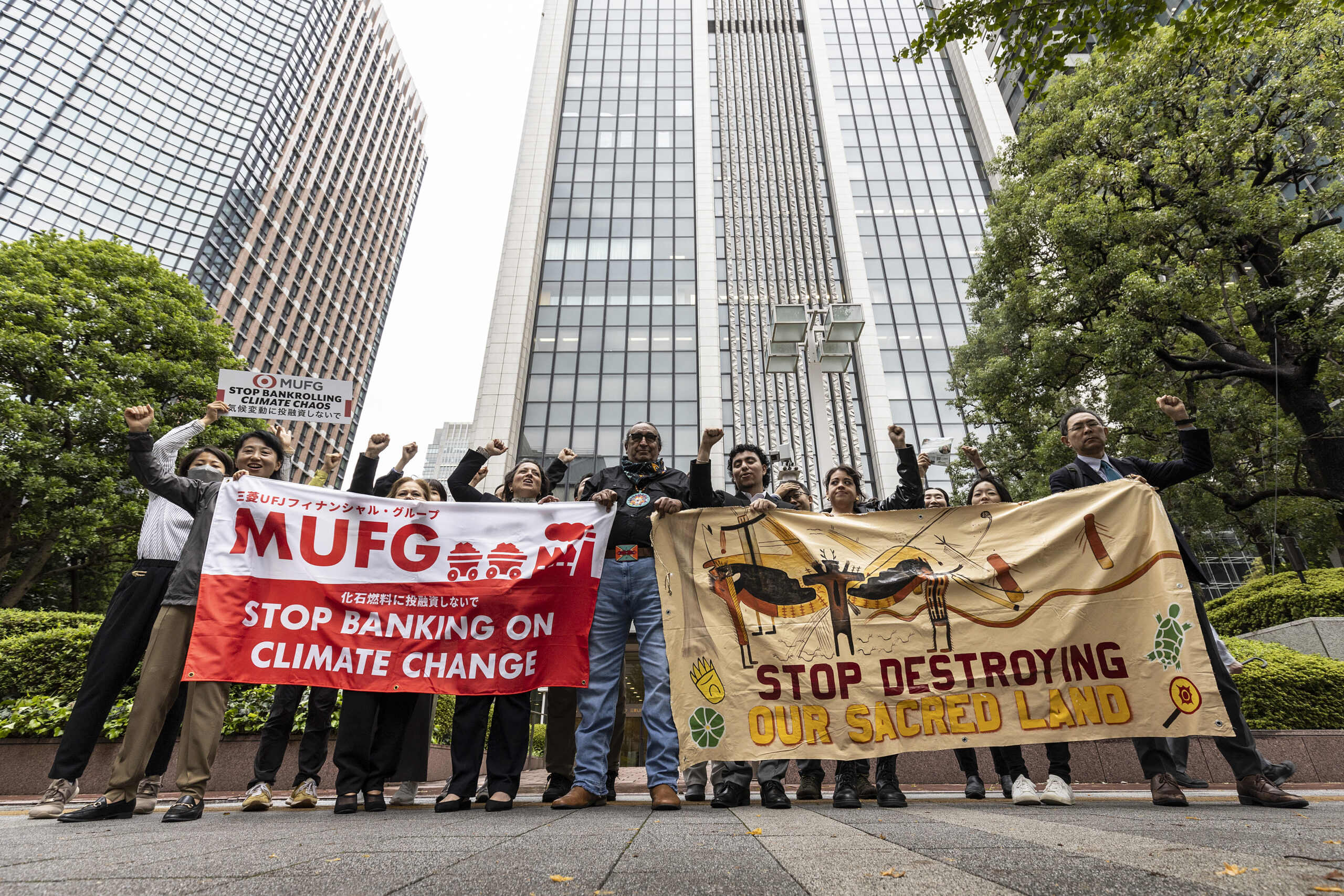
BOCC has driven shareholder advocacy. BOCC has been used to advance shareholder resolutions to advance climate action in US banks. It has had particular influence in Japan — one of the world’s top fossil fuel financial centers. BOCC informed climate action during the shareholder meetings of the Japanese megabanks MUFG, Mizuho, and SMBC, and drew sustained attention from the business press. At a press conference on the report’s 2025 release, RAN argued that Japanese megabanks should continue their net-zero efforts even after withdrawing from the Net Zero Banking Alliance, and that policy authorities should strengthen regulations. These arguments were published in Toyo Keizai, Japan’s largest economic magazine. The article ran the day of Mizuho’s shareholder meeting, with MUFG’s and SMBC’s the same week, likely sharpening pressure on all three.
BOCC has moved policy at individual banks. While bank-by-bank attribution of cause and effect is always imperfect, the BOCC era coincided with measurable advances in bank policies that did not exist when this work began:
-
- Arctic-drilling exclusions, mountaintop-removal exits, project-finance restrictions on tar sands and new coal mines, and energy-sector decarbonization targets at most major banks.
- Wells Fargo and JPMorgan Chase phased out financing relationships with the largest producers of mountaintop removal coal, and later cut lending to coal mining worldwide.
- Bank of America committed to reduce its financial exposure to coal companies. Goldman Sachs exited a contested coal export terminal.
- This all culminated in a “Paris Pledge” where several banks committed to end coal financing ahead of COP 21
Critically, the report has also documented when banks scrap those commitments — exposing rollbacks at Bank of America on Arctic drilling and coal, JPMorgan Chase’s restructuring of its emissions targets, and the wave of departures from the Net-Zero Banking Alliance after political pressure mounted in 2024–2025.
BOCC is read in legislatures and amongst financial regulators around the world. US Senators including Elizabeth Warren, Sheldon Whitehouse, Ed Markey, and others, have repeatedly cited BOCC findings.
-
- Senator Sheldon Whitehouse highlighted the BOCC in a speech on the floor of the Senate citing the irresponsibility of JPMorgan Chase, Citi, Bank of America, and Wells Fargo in their financing of fossil fuel expansion projects.
- The report was cited by members of Congress including Sens. Elizabeth Warren, Bernie Sanders, Martin Heinrich, Ed Markey, Sheldon Whitehouse, and Jeff Merkley to press the US Treasury Secretary in 2023 to take regulatory action on climate-related financial risk.
- BOCC has also been covered almost every year since 2021 in Green Central Banking: a specialized outlet written explicitly for the central banking and financial supervision community.
BOCC influences policy analysis, litigation and scholarship. BOCC was cited by the Intergovernmental Panel on Climate Change (IPCC) on the role of commercial banks in driving the climate crisis. Litigators in France and the Netherlands have used BOCC data to document bank attribution for climate harms. And countless academics and researchers have leveraged BOCC data to explore such issues as financial secrecy, fossil fuel finance phase out incentives, and impacts of fossil fuel financing on firm value. BloombergNEF relies on BOCC data to develop its Energy Supply Banking Ratio.
BOCC centers frontline communities. Unlike other fossil fuel finance data that has sprung up since 2010, the BOCC Coalition takes extra effort to pair data statistics with real life stories and studies authored by, and featuring, the frontline and Indigenous communities most directly affected by the projects banks are funding. From the Mountain Valley Pipeline in Appalachia to the LNG buildout along the US Gulf Coast, from Mozambique’s Cabo Delgado to the Vaca Muerta basin in Argentina, the report insists that financial flows are not abstract — they have addresses, casualties, and resistors.
How YOU can Support BOCC
- If you’re a policymaker or regulator: The BOCC+ dataset is a public good. We make underlying data, sector breakdowns, and bank-level analysis freely available for use in regulatory rule-makings, oversight hearings, and central-bank scenario analysis. Get in touch with our research team for briefings, technical methodology questions, or tailored data requests.
- If you’re a researcher, data analyst, or university: We regularly work with scholars and policy analysts working to integrate the BOCC data into the knowledge base on climate finance. Our research team would be happy to discuss research collaborations.
- If you’re a funder or supporter: Over the years, blood, sweat and tears — as well as philanthropic support — has made this work possible. Investment in BOCC has paid for itself many times over in policy outcomes, media reach, and the equipping of a global civil society infrastructure that did not exist before this report. Partner with us to power the next decade of this research. We see real opportunity ahead — to put this data in more hands, sharpen the link between financing and the harm it causes, and meet the moment as the climate crisis reshapes the financial system itself. Your support helps us build the next generation of the resource the movement relies on.
A Closing Thought
For seventeen years, Banking on Climate Chaos has done something the fossil fuel phase-out movement can’t do without: it has put a number on the problem: a $8.7 trillion line item, broken down by bank, by sector, by year, by company, by community.
We didn’t set out to publish this report seventeen times. The hope was always that the data would render itself unnecessary — that the world’s banks, faced with the cost of the climate crisis and the courage of the people on the frontlines, would simply stop financing it.
That hope has not been realized. In 2025, the world’s largest banks committed more money to fossil fuels than they did the year before. Until that hope is realized, the receipts will continue to be filed. Sustaining BOCC is how we ensure that — whatever the politics of the day — the public record of who financed this crisis remains in plain view.
17 Years of BOCC Reports
- Policy and Practice: Report Card on Banks and Mountaintop Removal
- Policy and Practice: 2011 Report Card on Banks and Mountaintop Removal
- Dirty Money – U.S. Banks at the Bottom of the Class: Coal Finance Report Card 2012
- Extreme Investments – U.S. Banks and the Coal Industry: Coal Finance Report Card 2013
- Extreme Investments Extreme Consequences: Coal Finance Report Card 2014
- The End of Coal? Coal Finance Report Card 2015
- $horting the Climate: Fossil Fuel Finance Report Card 2016
- Banking on Climate Change: Fossil Fuel Finance Report Card 2017
- Banking on Climate Change: Fossil Fuel Finance Report Card 2018
- Banking on Climate Change: Fossil Fuel Finance Report Card 2019
- Banking on Climate Change: Fossil Fuel Finance Report Card 2020
- Banking on Climate Chaos: Fossil Fuel Finance Report Card 2021
- Banking on Climate Chaos: Fossil Fuel Finance Report Card 2022
- Banking on Climate Chaos: Fossil Fuel Finance Report Card 2023
- Banking on Climate Chaos: Fossil Fuel Finance Report 2024
- Banking on Climate Chaos: Fossil Fuel Finance Report 2025
- Banking on Climate Chaos: Fossil Fuel Finance Report 2026